Austerlitz is usually presented as Napoleon’s perfect battle: he appeared weak, the Allies obligingly walked into his trap, the sun broke through the fog, and the French won almost as if the result had been written in advance. It makes a fine legend. It is also too tidy.
The event
The Battle of Austerlitz was fought on 2 December 1805, one year after Napoleon crowned himself Emperor of the French. The battlefield lay east of Brünn—modern Brno—near the town then known as Austerlitz and now called Slavkov u Brna in the Czech Republic. France faced the combined armies of Russia and Austria in the decisive battle of the War of the Third Coalition.
Napoleon had already wrecked the principal Austrian army at Ulm in October and occupied Vienna in November. That was an extraordinary campaign, but it had not ended the war. General Mikhail Kutuzov’s Russian army had escaped, gathered reinforcements, and joined surviving Austrian forces in Moravia. Tsar Alexander I and Emperor Francis II were both present. That is why Austerlitz became known as the Battle of the Three Emperors.
The French position was more dangerous than later triumphal accounts make it appear. Napoleon was deep in Central Europe, his forces were spread across a broad theater, Archduke Charles was bringing another Austrian army from Italy, and Prussia was watching for an opportunity to enter the war. Napoleon needed a decisive battle before his enemies could assemble more strength. The Allies had a simpler requirement: they needed to avoid giving it to him on his terms.
The strategic situation
Napoleon encouraged the Allies to believe that the French army was tired, isolated, and frightened of battle. He abandoned the commanding Pratzen Heights, entertained negotiations, and displayed a conspicuously weak right flank. None of that meant the French were safe. Deception works only if the enemy accepts the invitation, and Napoleon still had to hold his army together long enough for the decisive stroke.
The Allied leadership saw an opportunity to turn the French right, cut Napoleon away from the road to Vienna, and roll up his army. Austrian chief of staff Franz von Weyrother produced an elaborate plan that sent the first three Allied columns south from the Pratzen Heights toward Telnitz and Sokolnitz. A fourth column would follow, while Bagration and the Allied cavalry engaged the French left and guarded the Brünn road.
The idea was not complete foolishness. The French right really did appear vulnerable, and cutting Napoleon’s communications could have placed him in a serious position. The flaw was that the Allied plan assumed the French would remain passive while the coalition army conducted a complicated flank march in darkness and fog. It also emptied the strongest ground in the center—the very ground Napoleon intended to seize.
Kutuzov favored caution and understood the danger of attacking too soon, but his authority was compromised by the presence of the young Tsar and an aggressive court faction. The Allies had a nominal commander, a royal commander, an Austrian planner, and several column commanders who did not share one clear understanding of the battle. That is a poor arrangement on an ordinary day. Against Napoleon, it was an engraved invitation to disaster.
The battle as it happened
Before dawn: the Allied columns begin moving
The Allied plan was distributed late and explained during a council on the night before the battle. Units then had to find their routes and positions in darkness. Columns became delayed and compressed. Austrian cavalry crossed the path of Russian infantry while attempting to correct its deployment. The problem was not simply confusion; it was that the plan had almost no tolerance for confusion.
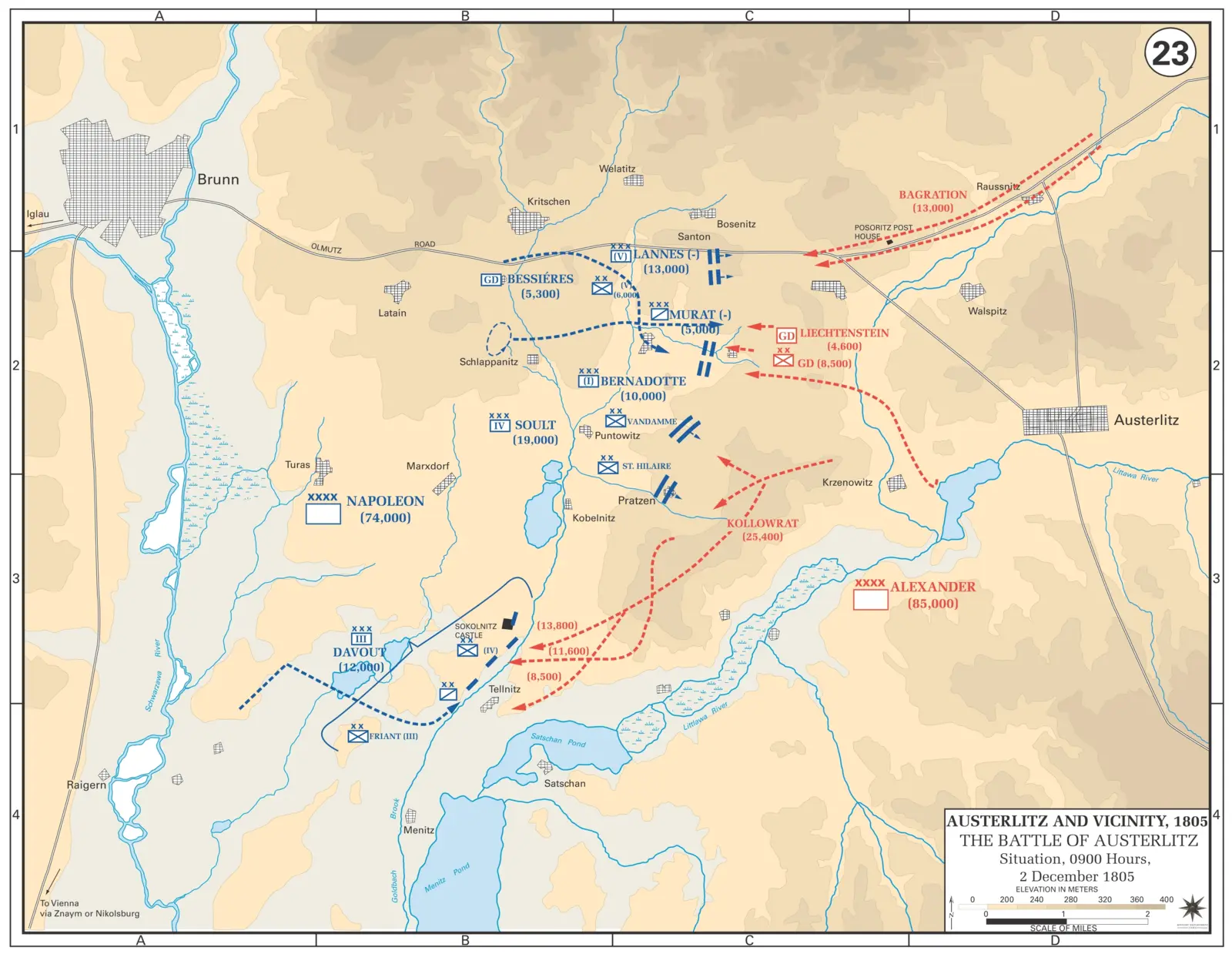
Around 7:00 a.m., Kienmayer’s advance struck Telnitz on the French right. Fighting spread toward Sokolnitz. The French defenders were heavily outnumbered but resisted long enough to slow the Allied timetable. Marshal Davout’s III Corps, arriving after a punishing forced march, fed troops into the southern fight. Napoleon had accepted weakness on that flank, but he had not abandoned it.
About 8:30 a.m.: the blow at the center
As the mist lifted, Napoleon could see that Allied troops were leaving the Pratzen Heights. He ordered Marshal Soult’s IV Corps forward. The divisions of Saint-Hilaire and Vandamme climbed toward the plateau, striking the weakened Allied center before the coalition command could fully understand what was happening.
This was the decisive movement, but it was not a parade. French battalions met fierce resistance around Pratzen village and on the heights. Units recoiled, officers fell, and control became difficult in the smoke. Saint-Hilaire’s men had to repulse repeated counterattacks. The French won the ground because their formations supported one another, local commanders acted quickly, and Soult’s corps maintained its direction despite severe pressure.
The northern fight
On the French left, Lannes and Murat fought Bagration and the Allied cavalry around the Santon and the Brünn road. This part of the battle receives less attention because it does not fit neatly into the story of the Pratzen Heights, but it mattered. Had the French left collapsed, Napoleon’s center could have been threatened from the north. Instead, Bagration was forced into an orderly withdrawal.
The Guard counterattack
The Russian Imperial Guard counterattacked near the heights and briefly checked the French advance. Napoleon committed his own Guard cavalry. General Jean Rapp’s charge helped break the Russian Guard cavalry and stabilized the center. It was another moment when the battle could still have become dangerous for the French. Napoleon’s advantage was not that nothing went wrong; it was that he possessed reserves, experienced subordinates, and a command system able to answer a crisis before it became a collapse.
The Allied left is trapped
Once the French controlled the heights, Soult could turn south against the rear of the Allied columns still fighting around Telnitz and Sokolnitz. Davout pressed from the west while the French center descended from the plateau. The Allied army was no longer conducting one battle. Its northern wing was retreating, its center had been broken, and its southern wing was trying to escape encirclement.
Some retreating troops crossed or skirted the frozen Satschan ponds under French artillery fire. Men, horses, and guns were lost, but later stories of thousands drowning belong more to Napoleonic propaganda than sound history. Napoleon’s proclamation magnified the episode because emperors understood publicity long before anyone invented social media.
Conclusion and cost
By early afternoon the Allied army was in retreat. Exact returns differ, as they often do after a battle of this size, but a reasonable summary is that Napoleon fielded roughly 73,000 men against perhaps 80,000 to 86,000 Allies. French losses were approximately 8,000 to 9,000 killed, wounded, and captured. Allied losses were about 27,000, including roughly 11,000 prisoners, along with a large number of guns and standards.
The consequences came quickly. Austria agreed to an armistice on 6 December and signed the Treaty of Pressburg on 26 December. The treaty imposed territorial losses and a heavy indemnity, removed Austria from the war, and confirmed French predominance in much of Germany and Italy. The Confederation of the Rhine followed in 1806. Emperor Francis then relinquished the crown of the Holy Roman Empire, ending an institution that had endured for roughly a thousand years.
Austerlitz did not make Napoleon invincible, but it made him appear so. That distinction matters. The victory intimidated opponents, strengthened French alliances, and encouraged Napoleon to believe that daring operational maneuvers could solve political problems. For the moment, he was right. Eventually, Europe learned to absorb the blow and keep fighting.
Battleward judgment
Why Napoleon won
Napoleon won because he controlled the purpose and tempo of the battle. He knew where he wanted the decisive action to occur, persuaded the Allies to weaken that point, and retained the reserves and command flexibility to exploit the opening.
- He made the Allies see what they wanted to see. The exposed French right confirmed their belief that Napoleon was vulnerable.
- He accepted risk without surrendering control. Davout’s arrival and the resistance at Telnitz and Sokolnitz gave the French right just enough strength and time.
- He concentrated at the decisive point. Soult’s attack did not merely take ground; it split the Allied army.
- French command was more coherent. The corps system and experienced marshals allowed local problems to be handled without abandoning the overall plan.
- The Allied plan was too complicated for the time, terrain, and command arrangement. It depended on synchronized columns moving cleanly through darkness and fog under divided leadership.
Luck still played a part. The mist concealed French movement, Allied choices matched Napoleon’s expectations, and hard fighting on the French right bought the necessary minutes. Calling Austerlitz a masterpiece is fair. Calling it inevitable is not.
If the other side had won
What would an Allied victory have required?
The simplest path was not a more brilliant attack. It was refusing Napoleon’s invitation. If the Allies had remained on the Pratzen Heights, waited for additional forces, and forced Napoleon either to attack a strong position or retreat toward Vienna, they would have improved their chances considerably.
Once the historical battle began, an Allied victory required two things: the coalition center had to hold or retake the heights, and the southern columns had to break the French right before Soult could turn against them. Either success by itself might only have produced a bloody draw. Together, they could have split Napoleon’s army and endangered his communications.
The Third Coalition survives the winter
A clear Allied victory would almost certainly have prevented the immediate armistice and the Treaty of Pressburg on Napoleon’s terms. Austria would have remained in the war, Archduke Charles’s army would still have mattered, and France would have faced a far more difficult campaign in Central Europe.
Prussia enters against France earlier
Prussia was already weighing intervention. A French defeat could have convinced Berlin that Napoleon was both dangerous and beatable. An earlier Prussian entry, coordinated with Austria and Russia rather than undertaken alone in 1806, could have created the broad pressure the Coalition repeatedly failed to sustain.
French control of Germany is delayed
Without Austerlitz and Pressburg, the Confederation of the Rhine probably would not have appeared in the same form or on the same schedule. The dissolution of the Holy Roman Empire might have been delayed. That would not have restored the old imperial structure to good health, but it would have denied Napoleon one of his greatest political reorganizations.
Napoleon’s empire collapses in 1805
This is possible only if battlefield defeat became catastrophe—Napoleon killed or captured, the Grande Armée destroyed, and France thrown into political crisis. A normal defeat would not have been enough. France still possessed a powerful state, veteran armies, and substantial territory. Napoleon had recovered from reverses before and would do so again.
What probably would not have changed
Britain’s victory at Trafalgar had already secured its command of the sea, while Austerlitz decided the immediate contest on land. An Allied victory in Moravia would not have erased French military power or automatically restored the old European order. Nor would it have cured the rivalries and command problems inside the Coalition. The most defensible conclusion is not that modern Europe would become unrecognizable overnight. It is that the Napoleonic system would have faced its first major check years earlier, before French control of Germany hardened into political structure.
Put it on the table
Recreating Austerlitz
A full battlefield treatment is a large undertaking. For Drums at Dawn, the strongest scenario is the central and southern action from roughly 7:00 a.m. to noon: the Allied descent from the Pratzen Heights, Soult’s assault, Davout’s arrival, and the struggle around Telnitz and Sokolnitz.
Place the Pratzen Heights near the eastern-center, the Goldbach and villages across the southern half, and the French approach from the west.
The Allies begin committed to their southern movement. Davout’s formations arrive under a timed or variable reinforcement rule.
Seize and hold the principal Pratzen objectives while preventing a decisive Allied breakthrough on the Vienna road.
Hold or retake the heights and drive sufficient strength beyond the French southern flank before the army is divided.
The scenario should punish neither player merely for failing to repeat history. Give the French a powerful central opportunity, not a guaranteed attack. Give the Allies their numerical strength, but burden the opening columns with the historical plan and divided command. Then include a free-deployment variant in which the Allied player may retain a stronger center. That second game asks the more interesting question: was Napoleon’s plan still brilliant when the enemy refused to cooperate?
Sources and notes
Where the account comes from
Troop strengths and losses vary among contemporary returns and later histories, so the figures above are presented as defensible ranges rather than false precision. Napoleon’s proclamation is used as a primary source for how the victory was presented, not as a neutral casualty report.
- Fondation Napoléon — Austerlitz timeline ↗
- Fondation Napoléon — The Battle of Austerlitz and the Principles of War ↗
- Fondation Napoléon — Austerlitz battlefield and aftermath ↗
- Army University Press — History in Motion: Napoleon 1805 ↗
- Napoleon’s proclamation after Austerlitz, 3 December 1805 ↗
- Napoléon & Empire — Battle narrative, forces, and loss estimates ↗
- U.S. Military Academy map — situation at 9:00 a.m. ↗
Hero painting: François Gérard, The Battle of Austerlitz, 2 December 1805 (1810), Palace of Versailles; public-domain reproduction via Wikimedia Commons.
Conversation
Reader comments
Discuss the article and keep the conversation civil.
Loading comments…