The German invasion of the Soviet Union did not meet an abstract army on an empty map. It struck soldiers, workers, children, and communities across many republics. Their war ran from the catastrophe of 1941 to victory in Berlin, with losses and moral questions that no triumphal photograph can settle.
The war in six turns
| Year | Phase | Main developments |
|---|---|---|
| 1940 | Unstable peace | Soviet expansion; Germany prepares its attack. |
| 1941 | Invasion and survival | Barbarossa, mass encirclements, Leningrad, Moscow. |
| 1942 | Southern crisis | Kharkiv defeat, German drive to the Volga, Stalingrad. |
| 1943 | The initiative turns | Sixth Army surrenders; Kursk and the Dnieper offensives. |
| 1944 | The westward advance | Leningrad relieved; Bagration; Poland and Warsaw. |
| 1945 | Defeat of Germany | Auschwitz liberated; Vistula–Oder offensive; Berlin. |
Whose war are we describing?
A history told from the Russian side sounds straightforward until we ask who fought. The state attacked in June 1941 was the Soviet Union. Its armed forces included Russians, Ukrainians, Belarusians, Jews, Kazakhs, Georgians, Tatars, Armenians, Uzbeks, and people of many other backgrounds. The worst-affected territories in the first years lay heavily in Ukraine and Belarus as well as Russia. Soviet citizens experienced the war differently depending on their place, nationality, age, military role, and relationship with Stalin's government. This article follows the Soviet side of the conflict with particular attention to the people who lived and fought within it. It does not assign their experience to one ethnicity. [2, 3, 18]
The Soviet term Great Patriotic War names the struggle against Nazi Germany from 1941 to 1945. It captures a genuine experience of resistance to an invader who intended conquest, exploitation, and mass death. It can also narrow the picture. The global war began earlier; the Soviet government had cooperated with Germany in partitioning Poland, attacked Finland, and annexed neighboring territory before Germany invaded. After victory, Soviet power did not mean liberation in the same sense to every person in Poland or the Baltic states. We can recognize the soldiers who defeated Nazi Germany without treating every action of their government as just. [1, 3, 18]
What follows is a chronological account from the unsettled year 1940 to the collapse of Berlin in 1945. Diaries and testimonies enter where they tell us something a campaign map cannot: hunger, medical shortages, the texture of fighting, the discovery of murdered communities. No one witness can stand for millions. A diary written at the time differs from a memoir shaped after the fact; a war correspondent had access and constraints that a private citizen did not. We will use those voices as evidence of particular lives, not as a shortcut around the larger record. [7–10]
1940: a dangerous peace
The Soviet Union was not yet at war with Germany in 1940. The nonaggression pact signed in August 1939 had permitted the two powers to divide Poland and establish spheres of influence in eastern Europe. Secret protocols mattered because they exposed the gap between public diplomacy and the fate of smaller states. The Soviet assault on Finland, begun in November 1939, ended in March 1940 after heavy fighting and Soviet territorial gains. The war revealed serious weaknesses in Red Army command and performance, though it also showed that the Soviet state could continue fighting and adapt. German observers drew lessons, not all of them sound. [1, 3]
In summer 1940 Soviet forces occupied and incorporated Estonia, Latvia, and Lithuania. The USSR also took Bessarabia and Northern Bukovina from Romania. These were acts of expansion and coercion, not defensive battles against German invasion. For people living in those territories, Soviet rule could mean arrests, deportation, and a loss of sovereignty. The fact that Nazi occupation later became catastrophic does not retroactively make Soviet annexation voluntary. A Russian-centered narrative that begins on June 22, 1941, would omit what the previous year meant to the new borderlands and to Germany's evolving strategic calculation. [1, 3]
Hitler ordered preparations for an invasion of the USSR in July 1940 after Germany defeated France. Stalin still traded with Germany and tried to avoid a premature clash. Soviet rearmament and deployment proceeded amid purges' lingering damage to leadership and a confused assessment of when the attack would come. Intelligence warnings accumulated, but warning that an enemy intends war is not the same as knowing the hour, direction, and political consequences of mobilization. Soviet decisions before June 1941 deserve criticism without pretending that a clean, universally accepted warning was simply ignored by everyone except Stalin. [1–4]
June 22, 1941: the border breaks
Before dawn on June 22 Germany and its partners attacked along an enormous front from the Baltic to the Black Sea. Aircraft struck Soviet airfields; ground forces crossed the frontier; communications and command arrangements unraveled. Army groups drove toward Leningrad, Moscow, and Ukraine. This was Operation Barbarossa, designed to destroy Soviet armed power in a rapid campaign. It was also a racial and ideological war. German planners expected to exploit Soviet food and labor while killing or allowing the deaths of vast numbers of people they deemed expendable. [2, 3, 19]
For a Soviet border unit the opening could be hours of bombardment, disconnected orders, and a retreat route already threatened. Other units fought stubbornly. The two facts belong together. German formations achieved tremendous encirclements in 1941, but the invasion was never a walk across empty territory. Soldiers held out at scattered positions, improvised counterattacks, and fought for roads and crossings while headquarters tried to reconstruct a picture of the front. Many did not know whether their families behind them had escaped. A general staff map can show an encirclement completed on a date; it cannot show how uncertain the situation was for the men inside it. [2–4]
Stalin's government called for resistance and mobilized the society it had often ruled by fear. Factories began moving east; workers, soldiers, railway employees, and local officials struggled to keep matériel and people ahead of the German advance. Scorched-earth orders denied resources to the invader but could worsen civilian hardship when evacuation failed. The state had immense coercive power, and it used it. So did millions of people who chose to fight because their homes and families were being attacked. Reducing every Soviet act to either terror or pure patriotic enthusiasm would make the first year incomprehensible. [2–4, 8]
The catastrophe in Belarus and Ukraine
German armored thrusts and infantry encircled Soviet forces near Minsk in June and early July, then took Smolensk after prolonged fighting. In Ukraine, the great encirclement around Kyiv in September destroyed or captured much of the Soviet Southwestern Front. Stalin's refusal to abandon ground and the difficulty of disengaging under attack contributed to the disaster. German success brought large areas and populations under occupation. It also consumed time, fuel, and men. Soviet resistance did not prevent the losses, but it made each German advance more costly than the short-war plan had allowed. [2–4]
Captured Soviet soldiers faced an especially terrible fate. German policy treated them as racial and ideological enemies outside the protections normally accorded prisoners. The United States Holocaust Memorial Museum estimates that about 3.3 million of the roughly 5.7 million Soviet prisoners taken by Germany died in captivity. Starvation, exposure, disease, forced labor, and deliberate killing were central, not accidental byproducts of a strained supply system. The prospect of capture therefore changed the meaning of an ordinary battlefield retreat. A soldier who laid down his rifle might enter a system with a high probability of death. [6]
The occupied landscape also became a killing ground for Jews. Mobile German killing units, supported by police, collaborators, and the wider machinery of occupation, murdered communities by shooting at pits and ravines. Babi Yar near Kyiv in September 1941 is one well-known site among many. Soviet wartime language often emphasized murdered peaceful citizens without identifying Jews distinctly, even when Jewish people were targeted as Jews. A truthful account has to say both that Nazi policy attacked Soviet society on a vast scale and that the Holocaust followed a specific genocidal program. Soviet Jewish soldiers and civilians confronted both wars at once. [2, 3, 12, 19]
The occupation was a war against civilians
German rule demanded food, labor, and obedience from people whose survival was not a priority of the occupiers. Villages lost grain and livestock; towns saw roundups for forced labor; anti-partisan operations could destroy entire communities. The Wehrmacht was deeply implicated alongside SS and police formations. To describe the eastern war as an honorable army fighting battles while crimes occurred elsewhere is historically false. Logistics and ideology worked together: troops lived from seized resources, and civilians bore the cost. In regions where Soviet rule had brought fear and repression, some initially hoped Germany might be preferable. Occupation often demolished that hope. [2, 3, 19]
People under occupation had choices, but seldom good ones. Some collaborated from conviction, opportunism, or survival; others concealed food, sheltered neighbors, joined partisans, or tried simply to keep children alive. The labels collaborator and resister can hide changing circumstances. A family might serve an occupying administration under compulsion while secretly helping relatives in the forest. A partisan unit might protect civilians and also requisition supplies from them. Jewish fugitives faced the additional danger of betrayal and antisemitism among people who otherwise opposed Germany. We should not invent a uniform Soviet civilian experience. [9, 12, 19]
Alisa Nussbaum Derman later described partisan activity in the forests after German forces occupied Slonim. Her testimony includes the effort to assist Jews, including children and older people, who escaped ghettos and killings. It illuminates a form of resistance whose first objective was keeping vulnerable people alive, not merely blowing up a rail line. Oral history recorded long after the event has the perspective and gaps of memory. Its value lies in her account of particular encounters, read beside records of occupation and the documented history of Jewish partisan groups, including those organized by the Bielski brothers. [9, 12]
Partisans and the contested rear
Behind German lines, resistance took many forms. Some Soviet soldiers escaped encirclement and continued fighting; local people gathered weapons, passed intelligence, sabotaged transport, or sheltered fugitives. Moscow eventually developed stronger links to some partisan formations, supplying and directing operations where it could. The forest was not automatically a safe refuge. A group needed food, local knowledge, discipline, and routes around enemy patrols. Destroying a railway line could delay German movement, but a reprisal against nearby civilians might follow. The military value and the human cost of an action belonged in the same calculation. [12, 19]
Partisan units were varied. Some protected Jewish families; others excluded Jews, robbed villagers, or treated political rivals harshly. German security forces used the presence of partisans as a pretext for collective punishment, but the responsibility for burning a village remained with those who ordered and carried out the crime. A person in an occupied district could fear both an occupying garrison and an armed group demanding food. The official Soviet account later presented a united people's resistance, which was partly true as a statement of scale and badly incomplete as a description of individual places. [9, 12, 19]
The Bielski group in Belarus is particularly instructive because its leaders prioritized the survival of Jews as well as armed activity. That priority complicates a war-game habit of measuring resistance only in destroyed trains and enemy casualties. A camp containing children and older people required hiding places, food, medical care, and decisions about whether to fight or move. Lisa Derman's later account similarly recalls assistance to fugitives. These examples should not be made into a claim that every partisan force behaved alike. They show that behind-the-lines warfare had objectives that rarely appear on an operational map. [9, 12]
Leningrad: a city made to starve
To the north, German forces and Finland's renewed war against the USSR isolated Leningrad. The blockade began in September 1941 and lasted until January 1944, though its military conditions changed over time. The city was not simply a static island waiting for a heroic relief. Soldiers defended its approaches; supplies crossed Lake Ladoga when possible; residents worked, buried the dead, and tried to obtain food as rations fell. Bombing and shelling killed people, but starvation became the defining threat. The first winter was especially catastrophic. [3, 4]
Tanya Savicheva, a child in Leningrad, recorded the deaths of family members in a small diary. The surviving pages have become an emblem of the siege. They are not a complete survey of the city, nor a license to turn a child's losses into decorative pathos. They document one household's destruction in a city where many households suffered similarly. Tanya survived the blockade but died in 1944 after evacuation. A diary this spare forces a historian to explain the food system, isolation, and scale of death around it rather than pretend the surviving lines tell every part of her life. [7]
Leningrad also challenges the habit of treating victory as the moment a city is no longer threatened. Keeping it from falling required costly offensives on surrounding fronts, the endurance of civilians, and sustained transport across dangerous routes. The blockade narrowed in January 1943 when Soviet forces opened a land corridor; it was not fully lifted until January 1944. By then starvation, disease, combat, and bombardment had killed on a scale that defies a tidy battlefield total. A separate article will have to examine the siege at the level of neighborhoods, ration cards, and individual winter days. [3–5, 7]
Moscow: the invader stops
In autumn 1941 German Army Group Center resumed its drive toward Moscow. The approach came through another set of encirclements, worsening weather, exhausted formations, and an opponent still raising and moving troops. Soviet authorities organized defenses around the capital; soldiers and civilians dug positions while many government functions prepared for possible evacuation. Fear was real. So was the decision to continue fighting. German forces reached dangerous positions near the city, but they could not convert distance traveled into the destruction of the Soviet state. [3, 4]
In December the Red Army counterattacked and drove the Germans back. Winter mattered: cold, transport failure, and inadequate preparation punished the invaders. It was not a supernatural Soviet weapon that replaced command, reserves, and tactical action. The Germans had underestimated Soviet capacity to generate new armies and continue the struggle after immense losses. Their supply system was stretched, their soldiers tired, and the political assumptions behind the campaign false. Moscow did not end the war. It ended the expectation that Germany could finish it quickly by one more march. [3, 4]
The Soviet winter offensives that followed also showed limits. Leaders pressed attacks across broad sectors, often against positions and supply conditions their formations could not overcome. Some gains were substantial; others cost men without breaking the German line. A history that jumps from the defense of Moscow straight to Stalingrad leaves out the soldiers sent forward in those difficult months. Surviving the invasion was an achievement. Learning how to conduct large, coordinated offensives against a still-dangerous German army took further time and a great deal more loss. [4, 5]
Inside a Soviet army: the medical diary
Sergei Aleksandrovich Semeka served as a medical administrator in the Soviet army and kept wartime diaries now held and described by the Hoover Institution. His notes complain of too few beds and medical workers, lack of transport to move hospitals as the front shifted, lice and typhus, frostbite, and the failure to bury the dead during an advance. Wounded men could be sent on foot with food to search for treatment. This is not the grand language of an official victory communiqué. It is a professional recording the gap between an army's stated obligation to its soldiers and what its medical system could actually deliver. [8]
Semeka had a particular vantage point. As an administrator he saw medical failures across units, not every soldier's private thoughts. His record can expose systemic problems but cannot tell us the frequency of a condition in every front or year. That limitation makes the diary more useful, not less. It prompts specific questions: how far was the next hospital, who controlled the transport, what happened after a breakthrough, and how many wounded remained outside the official story of a battle? Operational success could outrun ambulances. Retreat could strand patients. [8]
The familiar image of inexhaustible Soviet manpower becomes much harder to sustain when the wounded are treated as individual people. Recruiting a new soldier was not a free exchange for a lost one. A man had a family, training, language, and experience; a hospital needed staff, fuel, and time. Soviet commanders did use coercion and accept very heavy casualties. They also worked within institutions that struggled to care for survivors. A medical diary brings logistics and human endurance into the same frame, where they belonged throughout the war. [4, 8, 19]
1942: renewed defeat before Stalingrad
Early 1942 offered no simple continuation of Moscow's success. Soviet offensives ran into strong German defenses and overextended their own supply. In May a Soviet attack near Kharkiv ended in a major defeat when German forces counterattacked and encircled the attackers. The Red Army was learning, but the lesson was not a smooth curve of increasing skill. Decisions made under pressure could still destroy an army. Germany then prepared a summer offensive in the south aimed toward the Volga and the oil of the Caucasus. [4, 5]
German forces advanced across the steppe in Operation Blue, splitting their efforts between Stalingrad and the Caucasus. Soviet units retreated, sometimes under orders and sometimes because their position collapsed. The command's July Order No. 227, remembered for its insistence on no further retreat, reflected a real emergency and the state's punitive methods. Its implementation involved penal units and blocking detachments, but popular accounts exaggerate these into the entire story of Soviet fighting. Most soldiers fought in ordinary units amid a struggle for roads, river crossings, fuel, and the safety of cities. [4, 5]
For civilians, the southern campaign brought another wave of evacuation and occupation. Stalingrad, an industrial city on the Volga bearing Stalin's name, became an objective with logistical and symbolic weight. The river was a transport artery; the city's factories and crossings mattered. German air attacks devastated it in August. Residents who remained faced rubble, fire, hunger, and a battle moving through streets and cellars. To describe the coming fight only as a contest of two generals omits the people trapped between armies and the work needed to keep any defending unit supplied across the Volga. [3–5]
Who gave the orders—and who could question them?
Stalin directed a state in which military disagreement could carry political danger. The purges of the late 1930s had damaged command and encouraged caution about challenging superiors. In 1941 leaders had to make decisions with incomplete information while the political demand to hold territory could punish a prudent withdrawal. The scale of the defeats made change unavoidable. Commanders were replaced, new formations raised, and responsibilities adjusted. It would be wrong to describe the Red Army as a body of mindless officers waiting for instructions from Moscow; it would be equally wrong to pretend that fear did not shape the discussion around a map. [3–5]
Georgy Zhukov, Aleksandr Vasilevsky, Konstantin Rokossovsky, and other senior commanders brought experience to the planning of defensive and offensive operations. Their achievements rested on staff work, subordinate initiative, reconnaissance, and the capacity to bring armies into place. Stalin remained influential and could intervene for better or worse. Wartime memoirs by generals later became part of a contest over credit, and official narratives changed with Soviet politics. A commander who writes after victory can remember a clear plan where contemporaries saw conflicting reports and improvised repairs. The safest account asks what orders, movements, and outcomes can be documented before accepting the self-portrait. [4, 5, 13]
At lower levels, orders had to survive broken communications, wounded leaders, and a battlefield that changed faster than headquarters expected. Penal formations and blocking detachments existed, but they do not explain why ordinary rifle units held ruined buildings or crossed rivers under fire. Fear of punishment could make a man advance. So could loyalty to a friend, anger over a destroyed home, hope that a village behind him would survive, or the immediate knowledge that German captivity was deadly. These motives could coexist in the same person. Treating coercion and conviction as mutually exclusive choices is another way of making this war less intelligible. [4, 6, 8]
Stalingrad: hold the river, then close the ring
From late summer 1942 the German Sixth Army and supporting forces fought into Stalingrad. Soviet defenders, including Vasily Chuikov's Sixty-Second Army, held fragments of ground near the Volga. Front lines could pass through factory buildings and ruined housing. German artillery and aircraft inflicted enormous destruction, yet close fighting limited the advantage of some long-range fire. Soldiers were ferried across the river with replacements and supplies under attack. The city's defense was not a single continuous last stand; units were battered, withdrawn, reinforced, and reassembled in a struggle that changed daily. [4, 5]
The Soviet high command prepared a wider answer. German and allied troops stretched across long flanks beyond the city's immediate ruins. In November Operation Uranus struck principally at Romanian-held sectors north and south of Stalingrad. Soviet forces broke through and joined west of the city, encircling the Sixth Army and other troops. This was a planned, coordinated operational victory, not the spontaneous result of street fighting alone. The men defending the city had pinned an enemy in a costly battle; the counteroffensive transformed that commitment into a trap. [4, 5]
German relief attempts failed. The trapped force could not be sustained adequately by air, and surrender came in stages, ending in early February 1943. Mikhail Sandler, a Soviet Jewish veteran interviewed decades later, recalled the end of Stalingrad and the later path of his unit. Such retrospective testimony cannot replace an operational record, but it preserves the perspective of someone who lived through the transition from desperate defense toward advancing west. The victory was immense. It was also a city in ruins, a field of dead and wounded, and the beginning of more than two years of war rather than its conclusion. [5, 10]
The war's other front was labor
The Red Army could not have recovered without an industrial and agricultural struggle behind it. Soviet authorities moved factories, workers, and equipment eastward as the 1941 front collapsed. Production under new roofs or open skies was a feat of planning and harsh labor. Women, adolescents, older people, and evacuees filled jobs while able-bodied men were drafted. Housing, food, and safety were often inadequate. The language of a miraculous factory relocation can conceal who dismantled a machine, rode beside it, installed it again, and then worked long shifts to produce what the front demanded. [3–5]
Weapons output mattered, but so did rails, locomotives, fuel, boots, food, and trucks. Soviet production supplied the backbone of the war effort. Allied Lend-Lease provided important vehicles, food, raw materials, and other goods, especially useful as campaigns became more mobile and supply lines grew longer. The National Archives preserves the records of the United States program. A serious accounting should neither suggest that Western deliveries won the eastern war on their own nor erase the operational value of the supplies. Timing and category matter more than a simple percentage of all Soviet production. [5, 17]
Families experienced the home front through rationing, long separation, uncertainty, and news that might never come. Evacuation could save a life while uprooting it. Women served not only in factories and hospitals but in frontline medical, aviation, anti-aircraft, communications, partisan, and combat roles. The research of Roger Markwick and Euridice Charon Cardona documents that range and the obstacles women faced during and after service. The popular image of one famous woman sniper or one night-bomber unit can attract attention; it must not stand in for the much wider and less celebrated labor of Soviet women. [11]
1943: from Stalingrad to Kursk
After Stalingrad Soviet armies moved west, but the German front did not simply dissolve. Counterattacks around Kharkiv in early 1943 inflicted a sharp reversal. Both sides then concentrated around the Kursk salient, a large bulge in the line. Germany planned to attack its northern and southern shoulders in Operation Citadel. Soviet commanders prepared layered defenses and reserves, supported by intelligence that an offensive was coming. This was a different Red Army from the one caught on the frontier in June 1941: still vulnerable, but increasingly able to absorb an attack and organize several fronts for a larger response. [5, 18]
The July battle is often reduced to a single giant tank clash at Prokhorovka. The campaign was more complicated. German attacks made limited gains at heavy cost; Soviet defensive belts, artillery, mines, infantry, and armor blunted them. Soviet offensives then struck at Orel and Belgorod-Kharkiv. Arguments about precise tank losses and the degree to which events elsewhere forced Germany to stop Citadel should not hide the operational outcome: German hopes of regaining the initiative in the east failed. The Red Army would now launch successive major offensives. [5, 18]
That shift did not make each Soviet assault elegant or inexpensive. Breaking entrenched defenses required artillery, engineers, infantry, and replacements, and commanders could make costly mistakes. The concept of deep operations—a breach followed by forces exploiting into the enemy's rear—was not a spell that guaranteed a breakthrough. It demanded roads, bridges, fuel, communications, and cooperation across commands. Soviet success increasingly rested on doing those things at scale while forcing Germany to respond to several threats at once. That learning process cost a staggering number of lives. [5, 13]
Across the Dnieper and back into occupied lands
In the latter half of 1943 Soviet forces drove toward and across the Dnieper. The river was a major barrier with limited crossings, exposed banks, and German positions beyond it. Small bridgeheads could be won at enormous cost before engineers and supply officers could make them sustainable. Kyiv was recaptured in November. Each advance returned Soviet troops to territory where families had been killed, displaced, deported, or forced into German service. The word liberation was entirely apt for many survivors. It did not erase every fear of renewed Soviet rule or the complexities of life under occupation. [3, 5, 19]
Discovery of mass graves and destroyed Jewish communities changed what some soldiers knew about the war. Vasily Grossman, a Soviet Jewish writer and Red Star correspondent, reported from the front through much of the conflict, took notes, and later wrote about the Nazi murder of Jews in occupied territory. His notebooks and reports were assembled in English by Antony Beevor and Luba Vinogradova. His writing combines firsthand observation, interviews, and the shaping demands of publication under Soviet censorship. It is especially valuable for recovering the human scale of atrocities often submerged in general language. It should be read as reporting by a particular observer, not a verbatim diary of every combatant he met. [3, 19, 22]
The advance also raised hard questions about people who had survived under German control. Former prisoners, forced laborers, and civilians could face Soviet screening and suspicion on return. Actual collaboration had occurred, but the state's suspicion could encompass victims as well as perpetrators. Some ethnic communities were subjected to collective punishment and deportation under Stalin. These are not arguments that German occupation was benign; it was murderous. They are reminders that the end of Nazi rule did not make the Soviet state incapable of injustice toward the people it claimed to liberate. [3, 18, 19]
1944: Leningrad relieved, the center shattered
January 1944 brought the end of the blockade of Leningrad. Relief did not restore those who had starved or the buildings and families broken by years of siege. Across the front, Soviet forces pressed on in Ukraine and toward the old western borders. German commanders faced a widening shortage of troops and a strategic problem that no single local counterattack could solve. The Soviet Union could now concentrate material and experienced formations for attacks at several points while Allied pressure elsewhere tied down German resources. [3, 5]
In June Soviet forces launched Operation Bagration against German Army Group Center in Belarus. Preparation involved deception, massed artillery, coordinated breakthroughs, mobile exploitation, and partisan disruption behind German lines. Four Soviet fronts destroyed much of the German formation and advanced hundreds of miles. The date coincided broadly with the Western Allies' new front in France; the two offensives were separate operations that together deepened Germany's crisis. Belarus had already suffered catastrophic occupation. The returning army found devastated towns, murdered civilians, and a population whose liberation could not give back the lost years. [5, 13, 14, 19]
Bagration is a good answer to the claim that Soviet victory consisted solely of throwing men at German defenses. The operation displayed planning, deception, logistics, and flexible exploitation. That does not mean every Soviet unit was well led or that its losses were small. The Soviet army of 1944 could achieve an operational collapse of its opponent on a scale impossible for it in the opening weeks of 1941. Soldiers still crossed mined ground, took casualties, and relied on exhausted support services. Semeka's diary is a useful corrective whenever the sweep of an arrow on a map makes the advance look frictionless. [8, 13, 14]
The south, the Baltic, and the limits of one map
While Bagration tore open the German center, Soviet forces continued attacking in Ukraine and farther south. In August the Jassy–Kishinev offensive broke German and Romanian positions; Romania changed sides, and the strategic position around the Balkans shifted. The Black Sea and the approaches to the Caucasus had mattered since the 1942 oil campaign, and the southern advance altered the future of the region. A campaign history centered only on the road from Moscow to Berlin would obscure soldiers who fought in these theaters and civilians living through another turn in occupation and allegiance. [5, 19]
In the north, the long confrontation with Finland ended in a 1944 armistice after Soviet pressure and changing German fortunes. Soviet forces also moved toward the Baltic, where the annexations of 1940 and German occupation had created a bitter and complicated history. Some people greeted the defeat of Germany; others feared the return of Soviet institutions that had already deported neighbors. Local fighting did not pause while these political judgments formed. Men from different Soviet republics served in the advancing forces, and the communities they reached did not all understand liberation in the same way. [1, 3, 5]
The great arrows on a 1944 map can also suggest an army with infinite reach. The same vehicles, bridge units, medical personnel, and fuel stocks could not be everywhere. A front that advanced rapidly had to repair railways and bring depots forward, while German forces could still counterattack a spearhead. Soviet strategic planning coordinated several operations, but local results differed. Belarus was a crushing success; Warsaw became a political and human tragedy; other sectors required months of combat. The capacity to attack across a continent was real precisely because it had limits that commanders had learned to manage. [5, 13–15, 17]
Poland: victory meets another country's future
The Soviet advance into Poland made the meaning of liberation politically contested. Nazi rule had brought occupation, mass murder, and the destruction of Jewish life. The Red Army drove German forces back and ultimately ended their control. Yet the Soviet government also intended to determine Poland's postwar order, favoring a government aligned with Moscow rather than the Polish government-in-exile. Polish resistance organizations differed in loyalties and objectives. A story told solely as Soviet troops freeing one more country leaves out why many Poles feared the arrival of one powerful neighbor even as they needed the defeat of another. [1, 14, 15]
The Warsaw Uprising began on August 1, 1944, as the noncommunist Home Army tried to free the capital before Soviet forces entered it. German forces crushed the uprising with immense civilian suffering and destruction. Soviet armies were near the Vistula, and the failure to provide effective immediate assistance has remained bitterly disputed. Exhaustion and operational limits mattered; so did Stalin's hostility to an independent Polish underground. A brief survey cannot settle every question of available bridges, aircraft, and intent. It can state that the uprising was defeated while Soviet forces remained on the far side and that political conflict shaped how contemporaries and historians judged the inaction. [14, 15]
For a Soviet rifleman in Poland, war still meant dangerous fighting against German units. For a Polish civilian, the future of sovereignty could be as urgent as the next battle. For a Jewish survivor emerging from hiding, both the destruction of a community and the possibility of rescue were immediate realities. These views are not mutually exclusive. The eastern campaign was a military victory moving through a landscape of distinct national catastrophes. One label—liberation or occupation—cannot carry all of them without naming whose experience is being described and at what moment. [12, 14, 15]
Soviet soldiers, women, and memory
The Soviet army's vast casualty lists can make its members anonymous. Some volunteered early; others were conscripted after the front reached their region or after Soviet forces returned. A veteran of 1941 might lead men with only weeks of training in 1944. Units combined different languages and backgrounds, and combat could produce loyalty to comrades stronger than any slogan. Political officers and security organs monitored speech and obedience, while soldiers also read letters, bartered, complained, joked, and imagined home. The range is visible in diaries, letters, and oral testimonies that no official history could fully reproduce. [8, 10, 11, 18]
Women's wartime service likewise cannot be contained in a single uplifting story. Nurses and medics faced fire and shortages; pilots, gunners, partisans, and snipers held military jobs that challenged prewar expectations. Women workers kept production and transport functioning. They also encountered harassment, inequality, and a postwar desire to push their military contributions back into the background. Markwick and Cardona's study uses archives and memoirs to recover a wider set of experiences. Celebrating their courage is appropriate. Treating their presence as a novelty that needs no further explanation is not. [11]
The Blavatnik Archive's interviews with Soviet Jewish veterans, including Sandler, add voices recorded long after the fighting. They can preserve events and feelings absent from orders, but later knowledge and decades of public memory can shape recollection. Semeka's contemporary diary and Tanya Savicheva's brief family record offer different temporal distances from events. Grossman's wartime reporting has yet another form and audience. The historian should tell readers which kind of testimony is being used. Otherwise vivid details appear to carry an authority they have not earned simply because they are personal. [7–10]
1945: from the Vistula to Germany
In January 1945 major Soviet offensives drove west from positions in Poland. German forces were too thin and too battered to maintain a continuous defense everywhere. Soviet armies crossed successive rivers, approached the Oder, and entered German territory. The speed of the advance required transport, bridging, repair, and fuel; it was the culmination of years of painful institutional learning and material buildup. It was also a vast movement of refugees, prisoners, liberated forced laborers, and civilians caught between retreating and advancing armies. A campaign map that marks only front lines misses most of that traffic. [5, 17, 19]
On January 27 Soviet soldiers reached Auschwitz and found roughly 7,000 prisoners left behind in the main camp and associated sites after the SS evacuated many others on death marches. Soviet forces were fighting toward military objectives; freeing camps was not their primary operational plan. They nevertheless opened the sites and encountered evidence of industrial-scale murder. The victims included Jews in overwhelming numbers, as well as Poles, Roma, Soviet prisoners of war, and others. These facts belong inside the history of the Soviet advance, not as a separate moral appendix detached from it. [16, 21]
Germany's impending defeat did not make its remaining formations harmless. Defensive fighting in East Prussia, Pomerania, and along the approaches to Berlin cost both sides heavily. Soviet commanders coordinated huge fronts but also faced political pressure to finish the war and competition for objectives. The Red Army advanced with the memory of destroyed homes and murdered relatives. That memory helps explain fury; it does not excuse crimes against people encountered in Germany. The conduct of soldiers and commanders must be judged specifically, without treating every Soviet combatant as the same person or every German civilian as responsible for Nazi policy. [5, 19, 20]
Berlin and the end of the war in Europe
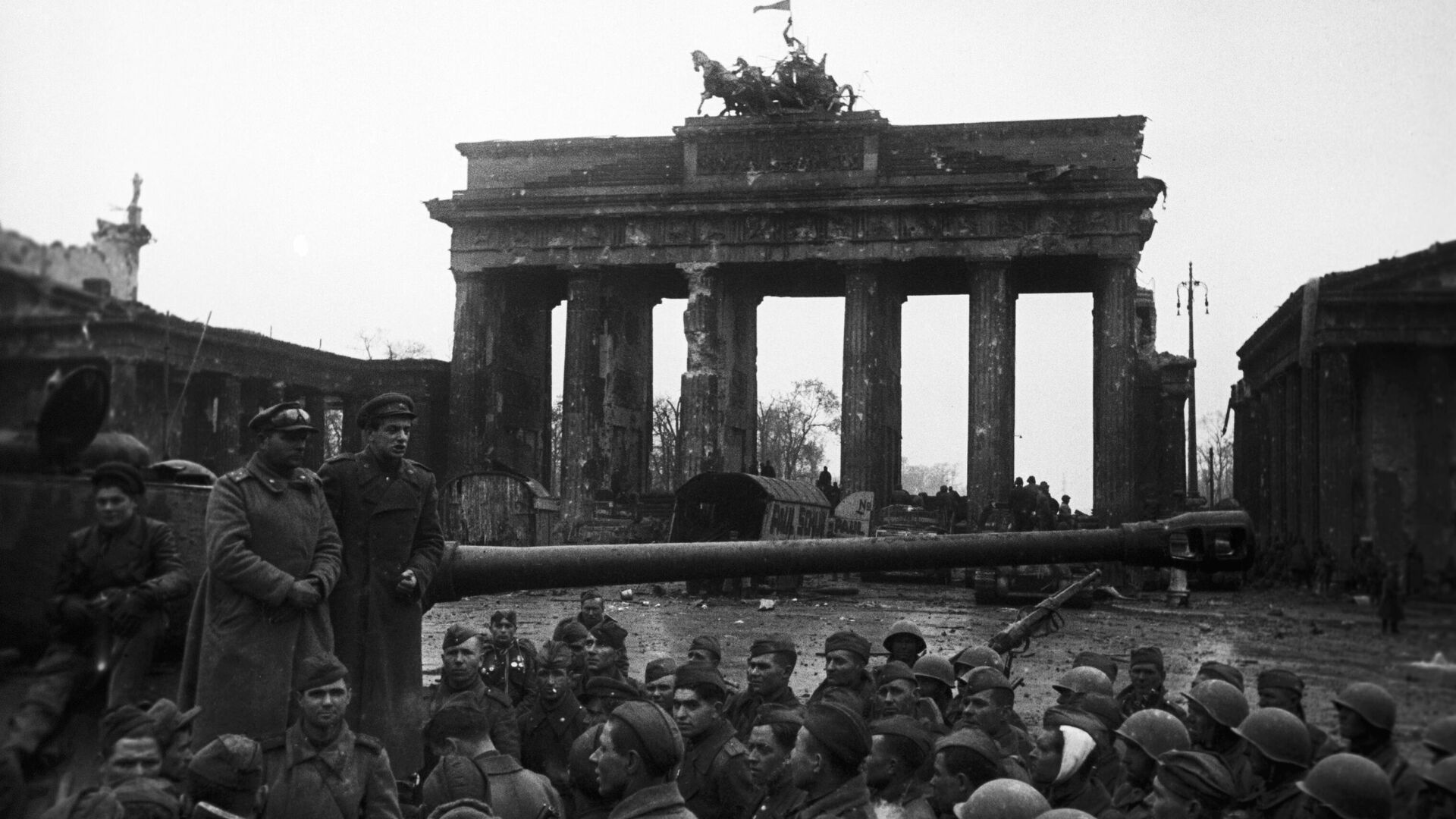
The final Soviet assault on Berlin began in April 1945. The fighting at the Seelow Heights and in the city demanded heavy artillery, engineers, infantry, tanks, and control of streets and buildings. German forces included depleted regular units and hastily mobilized defenders. Soviet commanders Georgy Zhukov and Ivan Konev led major forces approaching from different directions. Berlin fell in early May after Hitler's suicide. Germany's surrender took effect in Europe on May 8, marked as May 9 in Soviet remembrance because of the time in Moscow. Victory ended the Nazi assault on Soviet society. [3, 5]
A photograph of Soviet soldiers at the Brandenburg Gate can rightly convey relief and pride after years of sacrifice. It cannot tell the whole story of Berlin. Red Army soldiers also looted and committed extensive sexual violence against German women; the Imperial War Museums has addressed these crimes in its exhibition material. Some Soviet officers tried to restrain abuse, but the scale of suffering cannot be erased by pointing to individual discipline or German atrocities. It is possible to honor the defeat of Nazism and still state what Soviet troops did to civilians in the final campaign. [20]
For many who survived the front, the end was not a clean return to ordinary life. Cities and villages were ruined, families scattered, health damaged, and millions dead. Veterans carried wounds into a political system that celebrated victory while controlling how the war could be remembered. People repatriated from German captivity or forced labor could face suspicion. In Soviet-dominated eastern Europe, a new security order was taking shape. The war against Germany ended; its consequences for the people who had fought it did not. [3, 18]
What made Soviet victory possible?
No one cause is sufficient. Germany began with a powerful army and won vast victories, but planned a war whose assumptions about Soviet collapse, transport, occupation, and supply were disastrously wrong. Its policies of starvation and mass murder made resistance a matter of survival for millions. The Soviet Union possessed territory, population, industry, and a state able to mobilize them under extreme pressure. It lost armies and factories, relocated production, raised new forces, and learned to coordinate defense, counterattack, and deep offensive operations. Moscow, Stalingrad, Kursk, and Bagration were linked stages of that process, not four independent miracles. [2–5, 13, 19]
Leadership mattered, including commanders' growing ability to plan several fronts and exploit breaches. So did ordinary soldiers and civilians who endured conditions that strategic prose can make too easy to name. Allied aid made certain kinds of mobility and supply easier and tied Germany down on other fronts. The Soviet government's coercive practices could compel effort and also waste lives or punish people unjustly. An accurate account has room for all of those truths without apportioning victory by a single weapon count or using German memoirs to explain away a Soviet army that demonstrably became more capable. [5, 8, 13, 17, 19]
The costs are also resistant to one tidy number. Millions of soldiers and civilians died; the commonly cited total of about 27 million Soviet war dead is an estimate covering different kinds of loss and debated categories. German starvation policy, genocide, battle, siege, forced labor, disease, and Soviet choices all shaped the toll in different ways. Casualty figures are essential to grasping scale, but they cannot replace the distinctions among a prisoner starved to death, a Jewish child shot under occupation, a soldier killed crossing a river, and a Leningrad resident who died while searching for bread. [3, 6, 7, 19, 23]
How to bring this history to the table
A 1941 game should give the German player operational speed while forcing him to pay for fuel, distance, and the widening gap between what is captured and what can be supplied. The Soviet player should have disrupted commands and poor information but also real choices about delaying actions, evacuating industry, preserving formations, and holding a city or withdrawing. Capturing a marker named Moscow should not automatically end the game. Winning the war required destroying Soviet resistance and governing conquered territory, tasks Germany had not solved. Civilian murder should be stated as historical fact in scenario context, never converted into a victory-point trick. [2–4, 19]
For 1942, use two scales. An operational Stalingrad map shows the city's supply across the Volga and the exposed allied flanks; a tactical city scenario shows why a building can change hands repeatedly without deciding the campaign. An Operation Uranus scenario needs concealment, concentration, reserves, and the time required to close an encirclement. A Kursk scenario should make prepared defenses, intelligence, engineering, and follow-on offensives matter rather than staging one mythical duel between the largest tank counters. [4, 5]
For 1944 and 1945, give the Soviet player strong artillery and operational resources, then demand careful bridging, fuel distribution, medical support, and decisions about which breach to exploit. Bagration succeeds through coordination and deception, not an automatic numerical bonus. A game about Leningrad or occupation requires exceptional care: civilian suffering must be represented through historical narrative and choices about survival, supply, and relief, not entertainment built around starvation or genocide. We can game military decisions while acknowledging that some human experiences are better studied through testimony than simulated with dice. [7–9, 13, 19]
Conclusion: one article, many histories
The Soviet war against Germany began in a political landscape already damaged by the German-Soviet pact and Soviet expansion. The invasion of June 1941 brought a war of annihilation, catastrophic military defeats, occupation, and genocide. Soviet armies and civilians survived, defended Moscow and Leningrad, turned the southern campaign at Stalingrad, regained the initiative after Kursk, shattered German Army Group Center in Belarus, and fought to Berlin. Each step changed what the next one required. None was inevitable from the start. [1–5, 13, 19]
Personal accounts keep that sequence honest. Tanya Savicheva's diary records family loss under siege; Semeka's notes show the army's medical failures; a partisan survivor and a Stalingrad veteran remember different paths through the fighting. Their voices do not replace the campaign history. They stop it from becoming only arrows, commanders, and casualty totals. Victory over Nazi Germany was real and indispensable. So were Soviet repression, the uneasy experience of neighboring nations, and crimes committed during the final advance. A history that leaves out either side of that judgment has made itself easier by making the past less true. [7–10, 15, 20]
This survey is a beginning. Leningrad deserves an article about its own winters and people. Stalingrad needs a battle study that follows both the city and the encirclement. The occupation, the Holocaust in Soviet lands, women's service, Bagration, and Berlin each demand space that a general account cannot give them. Those closer studies can test and complicate the outline here. That is how a history library should grow: with a clear map of the war first, then the evidence and lives that no single map can contain.
Sources and method
Bracketed numbers refer to the sources below. Contemporary diaries, later interviews, journalism, archival descriptions, and military studies are different forms of evidence. We identify whose voice is being used and do not treat one memory as representative of the whole USSR. Figures for casualties and the scale of particular actions are estimates. The tabletop section is Battleward's proposed interpretation, not a rule found in a historical source. Further battle and civilian studies will examine the gaps left by this survey.
- [1] US Holocaust Memorial Museum, German-Soviet Pact and the 1939–41 relationship ↗
- [2] US Holocaust Memorial Museum, Invasion of the Soviet Union, June 1941 ↗
- [3] US Holocaust Memorial Museum, The Soviet Union and the Eastern Front ↗
- [4] US Army Center of Military History, Moscow to Stalingrad: Decision in the East ↗
- [5] US Army Center of Military History, Stalingrad to Berlin: The German Defeat in the East ↗
- [6] US Holocaust Memorial Museum, Nazi Persecution of Soviet Prisoners of War ↗
- [7] Los Angeles Museum of the Holocaust, pages from Tanya Savicheva's 1942 diary ↗
- [8] Hoover Institution, Sergei Semeka's wartime medical diaries ↗
- [9] US Holocaust Memorial Museum, Alisa Nussbaum Derman's oral history of partisan activities ↗
- [10] Blavatnik Archive, Mikhail Sandler's 2008 testimony on Stalingrad and later service ↗
- [11] Roger D. Markwick and Euridice Charon Cardona, Soviet Women on the Frontline in the Second World War ↗
- [12] US Holocaust Memorial Museum, Armed Jewish Resistance and the Bielski partisans ↗
- [13] US Army Combat Studies Institute, Analysis of Deep Attack Operations: Operation Bagration ↗
- [14] National WWII Museum, Operation Bagration and the road to Warsaw ↗
- [15] US Holocaust Memorial Museum, Warsaw Polish Uprising ↗
- [16] US Holocaust Memorial Museum, Soviet forces liberate Auschwitz ↗
- [17] National Archives, Soviet Lend-Lease records and their preservation ↗
- [18] National WWII Museum, Remembering the Great Patriotic War and its many peoples ↗
- [19] National WWII Museum, historian Jeff Rutherford on the Nazi-Soviet war and occupation ↗
- [20] Imperial War Museums, Unsilenced: Sexual Violence in Conflict exhibition guide ↗
- [21] US Holocaust Memorial Museum, Soviet forces and the liberation of Nazi camps ↗
- [22] Vasily Grossman, A Writer at War: Soviet journalist notebooks and reports, publisher record ↗
- [23] National WWII Museum, estimates of Soviet wartime dead ↗
Conversation
Reader comments
Discuss the article and keep the conversation civil.
Loading comments…