Rome did not conquer, govern, and defend its empire with a single unchanging army. Its soldiers' obligations, commanders, weapons, and homes changed as Rome itself changed. This history follows those changes from the Republic through the late empire and into the eastern Roman continuation.
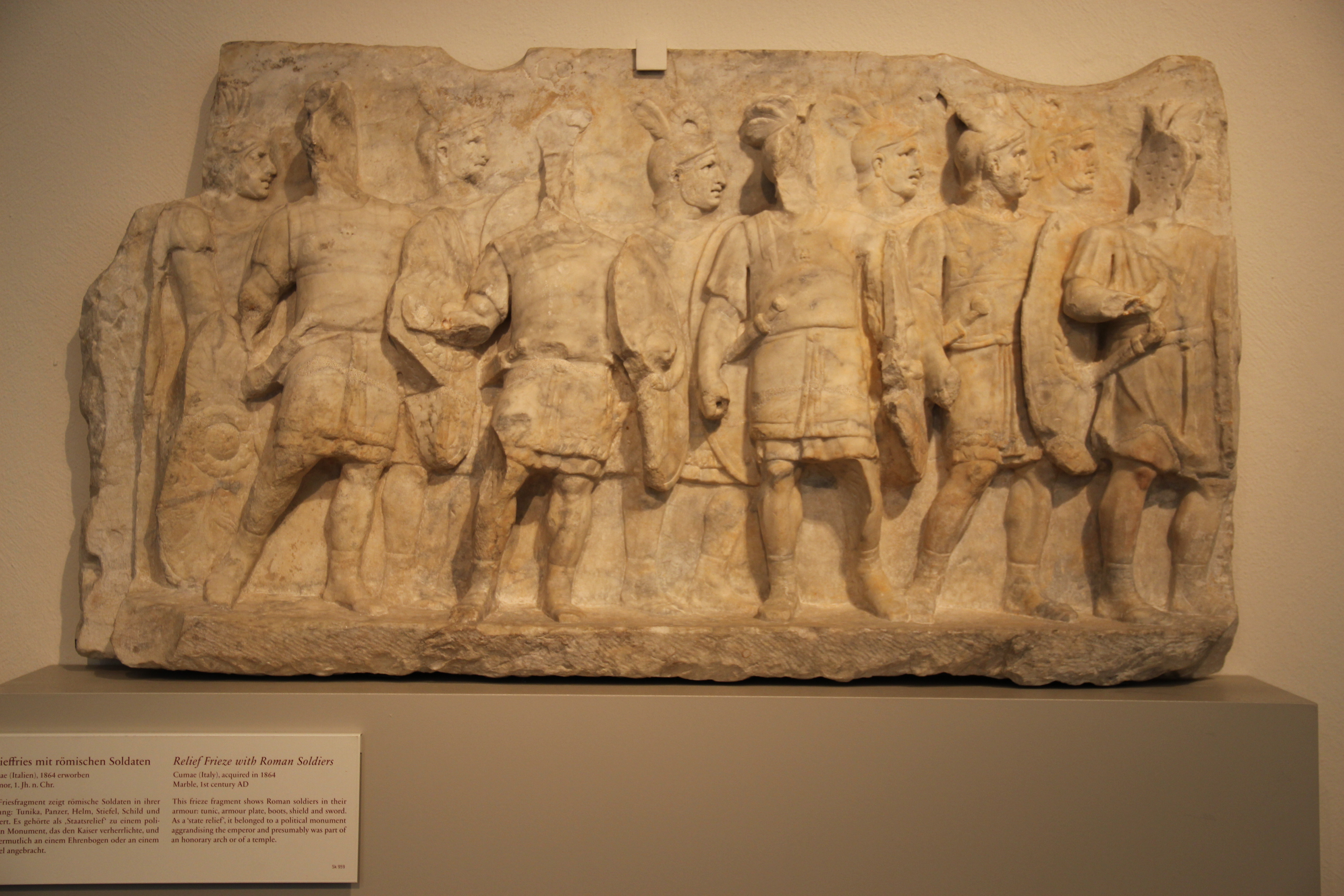
The problem with one Roman army
A legionary in the army that fought Hannibal did not serve under the same arrangements as a legionary on the Rhine under Augustus, and neither belonged to the army commanded by an emperor in the fourth century CE. The word legion survived, as did Roman claims about discipline and inherited greatness. The institutions behind those words changed. Recruitment, pay, command, citizenship, enemies, and the length of service changed with the state that supported them. To write a history of the Roman army is therefore to follow a series of bargains between soldiers and government, not to describe a single formation that lasted unchanged for a thousand years. [1–3, 8]
The evidence is uneven. Polybius gives an unusually detailed account of a middle Republican levy and camp, but he describes a system as he understood it, not every army Rome ever fielded. Imperial inscriptions and military diplomas reveal careers and legal rewards, while letters from Vindolanda show routine work. Josephus admired Roman preparedness but wrote with his own purposes. Late administrative lists record units and offices, though their dates and completeness demand care. The narrative below distinguishes a useful general pattern from a law that every province or campaign obeyed. [1, 4–7, 11]
A second trap is to make each change a story of improvement or decline. A dense citizen infantry army could be formidable at one kind of war and poorly suited to another. A frontier garrison might seem less glamorous than a campaigning legion, yet its patrols, information, and local relationships could prevent fighting. A mobile army did not make the border irrelevant. Roman military history is a record of adaptations made under political and fiscal constraints, sometimes successfully and sometimes at terrible cost. [3, 8–10]
Before the maniples: early Rome and its sources
The army of early Rome is difficult to reconstruct. Later Romans attributed a census organization of citizens by wealth and equipment to King Servius Tullius. The story may preserve memories of old social distinctions, but the account was written long after the supposed king. Archaeology can show weapons, fortifications, and regional exchange; it cannot confirm a neat royal reform program. It is safer to say that service and political standing were connected to property in the Republican tradition than to draw a precise seventh- or sixth-century order of battle from a later antiquarian scheme. [1–3]
Rome grew among other Italian communities that also used heavy infantry, cavalry supplied by wealthier men, and forms of collective fighting. The image of an isolated city inventing a uniquely Roman way of war obscures borrowing and competition. Conflict with neighboring peoples, then expansion through central Italy, made Rome's armies larger and its obligations more complicated. A field force had to march, find food, occupy ground, preserve alliances, and return with a political result. The history of the legion makes sense only within that expanding network of Italian communities. [1, 3]
The familiar account of a sudden switch from a Greek-style phalanx to a manipular legion after a defeat in the Samnite wars is too tidy for the evidence. Fighting in broken Italian terrain may have encouraged flexible subdivisions, but the exact date and cause are uncertain. By the period Polybius describes, the Roman legion was organized into smaller tactical bodies. We should not project that fully developed arrangement backward into every earlier century simply because later writers preferred a clear origin story. [1, 3]
The middle Republic: levy, allies, and service
In Polybius's account of the second century BCE, the consuls called citizens for military selection. Men were assigned to legions, and age and wealth influenced their place in the infantry and their equipment. Service was a civic obligation, not merely an individual job application. The army also relied heavily on the Italian allies, usually called socii, who provided substantial contingents under treaties with Rome. A Roman army on campaign was thus a coalition led by Rome. Calling every man in it a legionary conceals the allied infantry and cavalry who carried much of its fighting burden. [1, 3]
Polybius describes a normal legion of about 4,200 infantry, expandable in emergencies, with roughly 300 cavalry. Two legions for each consul, accompanied by allied forces, provide his standard picture; wartime armies frequently departed from the norm. His figures are a description of organization, not a promise that every legion in the field had its paper strength. Casualties, detachments, sickness, and recruitment changed the actual body of men. The distinction between an authorized establishment and soldiers present for duty will recur throughout Roman history. [1, 5]
The alliance system multiplied Rome's manpower, but it created obligations. Allies were expected to fight and bear losses without possessing the same Roman political rights. They had their own communities and leaders, and their willingness to remain depended on more than the outcome of a single battle. Hannibal understood this when he tried to fracture the Italian coalition. Rome's eventual survival in the Second Punic War owed much to its ability to replace armies and keep enough partners committed. Military strength was a property of the state and its relationships, not simply the shape of a legion's formation. [1, 3]
How a manipular legion fought
The middle Republican infantry in Polybius is conventionally described in three lines: hastati, principes, and triarii, with lighter-armed velites moving ahead and through the gaps. The first two heavy infantry lines were divided into maniples; the triarii formed a smaller third line. Intervals and depth created the possibility of relief, reinforcement, and maneuver. This was not a machine that automatically exchanged one entire line for another on a whistle. Smoke, dust, uneven ground, casualties, and local command shaped what could be done in practice. [1]
The heavy infantry carried a large shield, throwing spear or pila, and sword, though equipment varied over time and by individual means. The velites skirmished and screened; cavalry could scout, fight, or pursue. An army's effectiveness depended on the timing among these elements. A line could absorb pressure, exploit an opening, or break when the wrong flank was exposed. At Cannae in 216 BCE, a huge Roman mass pressed through the Carthaginian center yet became vulnerable on its sides and rear. The episode shows both the striking power of Roman infantry and the danger of treating depth as a substitute for command and space. [1]
Modern diagrams make the maniples look like fixed rectangles with perfect streets between them. Polybius provides a framework, not a photograph. The exact formation adopted against a hill fort, a cavalry-heavy enemy, or a city wall could differ. Roman commanders assembled temporary detachments and learned from opponents. The attraction of the manipular system was room to organize several bodies of troops within a larger force. Its limitation was the same as any ancient system: orders had to be made intelligible and carried out by tired people under threat. [1, 3]
The army beyond the battle line
Polybius devotes attention to the Roman marching camp because the camp was part of the army's method. Officers assigned places for units; soldiers raised defenses; watches and signals organized security. A regular layout made a large body easier to move and control. It also gave troops a protected base after battle or during an uncertain campaign. The ability to build and inhabit a camp did not make Romans invulnerable. It did reduce the number of problems a commander had to solve afresh every evening. [1]
Food, fodder, water, pack animals, roads, and local markets determined where an army could operate. Roman armies could requisition and purchase supplies, carry provisions, and use river or sea transport. Success in battle might open a route, but it did not fill grain wagons by itself. Siege warfare demanded engineering, labor, and patience. Rome's expansion involved camps, fortifications, naval movement, and long efforts against strongholds as much as set-piece battles. An account that counts swords but ignores grain and transport will often misidentify why an army advanced or stopped. [1, 3]
Discipline was real and could be severe, yet the Roman reputation for obedience should not be detached from rewards and shared expectations. Soldiers sought pay, booty, honor, land, and the fulfillment of obligations to families. Commanders had to distribute work and prizes, maintain trust, and sustain a campaign through hunger and bad news. Polybius's description of punishments shows one part of this bargain. The soldiers' readiness to endure service depended also on whether the state could support them and whether victory seemed likely to benefit them. [1–3]
Overseas wars change the bargain
The Punic wars and subsequent conquests forced Roman armies to serve farther from home and for longer periods. Spain in particular required a sustained commitment. The older picture of a farmer leaving his land for a short campaign and returning each autumn cannot explain every second-century posting. Even when the formal citizen levy remained, service could become an extended occupation. Some men accumulated experience and expected further military work; others had to cope with lost labor at home. The social consequences of conquest were disputed in Roman politics, but prolonged service itself is unmistakable. [2, 3]
Rome's overseas empire brought treasure and slaves, new provinces to garrison, and more commanders competing for credit. Military needs were never purely tactical. A governor held coercive power far from Rome; a victorious general could build obligations among his soldiers and clients. Triumphs and public prestige encouraged ambitious campaigns. Meanwhile Italian allies continued to supply manpower without equal citizenship. The Social War of 91–88 BCE, in which Rome's Italian partners fought for political rights, remade the civic basis of recruitment. The extension of citizenship did not erase regional identity, but it changed who was legally inside the Roman military community. [2, 3]
The longer arc matters more than a single invention. A state governing territory from Spain to the eastern Mediterranean needed standing commitments, repeated levies, specialists, and commanders who knew their troops. It also needed reliable ways to end service. Disputes over veteran settlement became disputes about political power. They would help pull the army into the Republic's internal struggles. It is a mistake to treat this as a tactical story of better weapons alone; the central problem was who would pay soldiers, reward them, and command their loyalty. [2, 3]
Marius and a reform that was not one event
Gaius Marius recruited men without the traditional property qualification for his campaign against Jugurtha in 107 BCE. The episode is significant, but it is often burdened with changes that cannot all be dated to that year. The property threshold had already been reduced over time; volunteer service and long campaigns were not created from nothing. Conscription continued in the late Republic. The cohort became increasingly important as a tactical unit over a longer development, while the eagle standard and other practices acquired their own histories. A package labeled the Marian reforms makes a complex transition deceptively simple. [2, 3]
A cohort grouped several maniples into a larger body, giving commanders a convenient unit for maneuver and independent tasks. It did not abolish every smaller subdivision or every old term overnight. Caesar's legions still had centuries, officers, specialists, and flexible arrangements for particular fights. Ancient armies are especially resistant to the idea that a date in a textbook can switch all field units to a new organization. Veterans carried habits forward; commanders adapted; recruitment needs differed between wars. The cohort's value was practical command at campaign scale, not proof of a single designer's perfect system. [2, 3]
The larger political change was the bond between soldiers and successful generals. Men who served for years could look to a commander for booty and retirement land when normal institutions proved unreliable. That did not mean they ceased to think of themselves as Romans or always obeyed one man without hesitation. It meant that a general with an army could become a rival center of power. The civil conflicts of Marius and Sulla, Pompey and Caesar, and later triumvirs showed how dangerous that arrangement was for a Republic whose magistrates were supposed to hand command back. [2, 3]
Caesar's legions and the collapse of Republican command
Caesar's campaigns in Gaul from 58 to 50 BCE reveal an army capable of rapid marches, elaborate siege works, coordinated detachments, and hard fighting in unfamiliar country. His own Commentaries are indispensable and self-serving: they explain decisions to a Roman audience while building his reputation. The army's achievements should not be credited solely to its commander. Experienced centurions, engineers, scouts, cavalry, allied troops, and ordinary soldiers turned orders into bridges, camps, and battle lines. It was a system of accumulated skill sustained through repeated campaigning. [2, 3]
In 49 BCE Caesar crossed into Italy with troops whose legal duty to the Republic and practical attachment to him were in tension. Civil war did not follow mechanically from a new sword or a new cohort. It followed from a political order unable to settle questions of command, prosecution, prestige, and veteran rewards without armed coercion. Opposing armies were Roman too. At Pharsalus in 48, professional experience and command decisions mattered, but victory could not repair the constitutional arrangement that the war had broken. The subsequent struggles after Caesar's murder made the point brutally clear. [2, 3]
The late Republican army thus poses an awkward lesson. Long service created capable formations, but the state did not yet have an accepted monopoly over their future. A general could promise settlement and use a provincial command to build a constituency. Soldiers could choose sides or refuse orders; their choices were neither purely ideological nor purely bought. Any account that calls this simply the replacement of an amateur army by a professional one misses the political question: professional in whose service, under which rules, and paid by whom? [2, 3, 15]
Augustus makes an imperial army
After the civil wars, Octavian, known as Augustus from 27 BCE, reduced the enormous forces assembled by competing leaders and established a more regular army under his own authority. Roughly 28 legions remained for much of his reign, though numbers changed with campaigns and losses. Legions were stationed primarily in the provinces where the emperor held military command. They were no longer normally raised for a single annual expedition and then disbanded. Augustus also had to settle veterans, finance continuing pay, and make the princeps appear the source of military reward. [2, 3]
Terms of service and discharge payments became more regular, though policy changed and soldiers still complained. The military treasury, aerarium militare, established in 6 CE, was one attempt to fund veteran benefits. The army's costs were a permanent obligation of empire. Command formally involved governors and officers, but the emperor's authority tied the provincial armies to the center. This was a political solution to the late Republic's problem, not an immunity from civil war. A claimant who won enough soldiers could still contest the throne; the events of 69 CE made that danger obvious. [2, 3]
Augustus's arrangement included far more than the legions. Auxiliary units supplied infantry, cavalry, archers, and other capabilities; fleets, guards, and urban forces fulfilled different tasks. The auxilia drew heavily on noncitizens and, over time, granted citizenship and legal privileges on honorable discharge under defined conditions. The line between citizen legion and noncitizen auxiliary was meaningful, but armies fought as combined forces. It is misleading to put a legion on a map and imagine it performing every patrol, reconnaissance mission, and cavalry pursuit alone. [2, 4, 6]
Legion, auxiliary, and the people behind the labels
An early imperial legion had a nominal strength often summarized at about 5,000 men, but actual numbers varied and detachments might be elsewhere. Centuries, cohorts, senior centurions, standards, and a chain of officers organized daily work. Centurions were central to training and command, though their careers differed. Legionaries could build roads and forts, quarry stone, haul supplies, and perform administrative tasks as well as fight. The image of every soldier standing in full equipment on a frontier wall every day is a modern simplification. [2, 4, 5]
Auxiliary formations were no less part of the Roman army because their recruits entered by a different legal route. Unit names often retained an ethnic origin long after recruitment became local or mixed. A cavalry ala, an infantry cohort, and a mixed cohort could solve different problems; provincial commanders had to combine them. The military diploma is unusually concrete evidence for service and reward. A bronze document recorded the grant of citizenship and other rights to qualifying veterans and, under particular legal rules, their families. Its formula also reminds us that the legal terms shifted over time. [4, 6]
The binary picture of Roman legionary versus foreign auxiliary also obscures people within the ranks. Recruits came from many provinces. Some veterans settled near their former bases. Soldiers formed households and relationships even when law restricted formal marriage during service; women and children lived in the social world around forts. Enslaved people, traders, artisans, and local suppliers sustained military communities. Archaeology and documents put them back in view. An army was a set of households, markets, and roads as well as a roster of armed men. [4–6, 15]
A frontier was a zone of work
The imperial army is often pictured as a thin line defending a fixed border against a permanent external enemy. In practice, rivers, roads, forts, client rulers, and negotiated relationships formed different frontier systems in Britain, along the Rhine and Danube, in North Africa, and in the east. Garrison units watched movement, policed routes, escorted officials, gathered information, and sometimes projected power beyond a formal boundary. Major campaigns could draw troops away from forts. A frontier was a region of contact and resource management, not merely a wall. [2, 4, 8]
The Vindolanda tablets from northern Britain expose the routine beneath the strategic map. A strength report for the First Cohort of Tungrians records men in the unit, men absent on various duties, and those present at the fort, including unfit men. The document's precise categories require interpretation, but its plain lesson is powerful: nominal strength did not equal men available for a battle today. Soldiers were dispersed on assignments, and administration mattered to readiness. A scenario that places every figure on the field because the roster says a unit exists misses much of military life. [5]
Josephus describes Roman training, order, camps, and preparation in his account of the Jewish War. He witnessed Roman operations and understood the force he was describing, yet he had reasons to emphasize its excellence. The Jewish revolt also shows how siege, logistics, local politics, and brutal coercion worked together. Roman military power could be technically impressive and devastating to civilians. An analytical history should hold those facts together rather than convert a description of competence into an endorsement of every campaign. [7]
Equipment, tactics, and variation
The imperial legionary with segmented armor, a rectangular shield, two pila, and a short sword is a recognizable image, but it is not a universal kit for all imperial centuries. Mail and scale armor coexisted with segmented armor; shields and helmets evolved. Region, supply, date, rank, and personal means mattered. Surviving monuments and excavated objects illuminate particular places and moments, while artistic convention can exaggerate uniformity. Roman soldiers did not receive one immutable equipment set from Augustus to Constantine. [4, 8]
Tactics changed with enemies and terrain. Roman commanders could use fortified camps, infantry lines, cavalry, missiles, surprise, engineering, and diplomacy. In the east, wars with Parthian and later Sasanian forces posed different operational challenges from a rebellion inside the empire or fighting in the forests and river valleys of Europe. Cavalry was never absent from the early imperial army; later armies did not suddenly discover horses. What changed was the organization and relative emphasis of mounted forces, and the combinations of troops a commander could bring to a campaign. [2, 8]
Neither discipline nor tactical doctrine guarantees victory. The destruction of three legions under Varus in 9 CE showed the danger of intelligence failure, difficult terrain, and local revolt. The suppression of revolts and conquest of provinces also brought harsh losses for opponents and civilians. Roman success over centuries came partly from capacity to replace losses and continue operations, and partly from political integration and extraction. A perfect tactical diagram cannot capture that capacity. The state behind the army remained as important as the soldiers at the point of contact. [2–4]
The second century and the scale of empire
The second century CE is sometimes made into a static golden age: emperors on the frontier, legions at their bases, and a quiet empire. It was not uniformly peaceful. Trajan fought in Dacia and campaigned in the east; Hadrian consolidated and inspected; Marcus Aurelius confronted prolonged wars on the Danube while disease and succession weighed on the state. Each campaign drew on provincial manpower and supply. The empire's geographic breadth made concentration difficult. Moving a force to one crisis could expose another district or delay the time needed to respond. [2, 4]
Fortifications and military roads were investments in movement and communication as well as barriers. A fort could support patrols and supply lines; a road could bring reinforcements or tax collection. Commanders could not hold every mile with equal density. They needed intelligence from neighboring communities and a workable relation with local elites. The army's role in taxation, construction, and provincial society made military history inseparable from administration. Even a decade without a famous battle could contain many acts of coercion, negotiation, and preparation. [2, 4, 8]
The soldier's service remained a career and a risk. Pay, bonuses, and prospects varied; deductions and delayed rewards caused complaints. Veterans might receive money or legal status and settle in provinces, extending Roman institutions in ways no victory monument could show. Scholars have questioned whether the modern word professional accurately describes all aspects of this army. It had long-serving specialists and formal routines, certainly, but recruitment, social status, coercion, and career expectations were not those of a modern national force. [4, 6, 15]
Third-century crises and experiments
In the third century, emperors and rivals fought repeated civil wars while the empire faced major external campaigns, epidemics, and fiscal strains. The period was neither an uninterrupted collapse nor a single military reform. Septimius Severus, who gained power after civil war in 193 CE, increased the military's political weight and altered pay and service conditions. Later rulers assembled forces for rapid campaigning, drew on cavalry and detachments, and competed to hold territory and allegiance. A unit might fight one emperor's external war and then another claimant's civil war. [8]
Caracalla's grant of Roman citizenship to most free inhabitants of the empire in 212 CE altered the old legal distinction between citizen legionary and noncitizen auxiliary. Unit names and traditions did not instantly disappear; institutional inheritance can outlive the rule that first gave it meaning. As the empire changed its tax base and sources of recruits, it also had to provision armies under currency instability and pressure on transport. Military effectiveness depended on reliable supply and political coordination, both harder to guarantee when rival courts demanded resources. [4, 8]
Major defeats and territorial losses were real. So were recoveries. Emperors such as Aurelian restored imperial control over breakaway regions in the 270s. That recovery required mobile operations, commanders with loyal forces, and the ability to translate victory into durable administration. The third century should therefore be treated as a sequence of crises and adaptations rather than a straight road down toward 476. Later emperors inherited both exhausted structures and hard-won lessons about how to move armies across a vast territory. [8]
Diocletian, Constantine, and new layers of command
Diocletian's accession in 284 CE and the tetrarchic experiment distributed imperial authority among several rulers. Smaller provinces and new command arrangements made the state more elaborate, while military establishments expanded and shifted. Constantine's victories in civil war and his long reign further shaped a system in which field forces attached to imperial command and frontier forces held permanent districts. Historians disagree on the exact steps and dates. It is safer to speak of a transformation spanning late third- and fourth-century reigns than to assign the finished army to one reformer. [8–10]
The terms comitatenses and limitanei describe broad categories of late Roman field and frontier soldiers. The former were associated with mobile imperial or regional field armies; the latter occupied frontier districts. The distinction became clearer under Constantine, but it does not mean that every frontier soldier was a farmer who could not fight, or that every field unit could move instantly from one end of the empire to another. Frontier armies could fight serious campaigns; field armies still needed supply, roads, and time. Status and pay differed, and units could change classification. [8–10]
The later Roman command structure also separated many civil and military responsibilities and developed offices such as the dux and magistri militum. Those titles varied in authority by date and region. Smaller units and detachments complicate direct comparison with a second-century legion of nominally several thousand men. The old name legion survived on rolls, but one cannot infer an Augustan order of battle from it. The imperial government was trying to defend multiple threatened regions while guarding against generals with enough concentrated power to seize the throne. [8–11]
Reading the late army without a decline myth
The Notitia Dignitatum lists late imperial offices and units in western and eastern sections. It is valuable evidence for how an administration represented its commands. It is not a dated, audited count of every soldier who could assemble on a specific day. Sections reflect different moments, and names could remain on a list after circumstances changed. A historian who adds all the entries and announces a precise army size has mistaken an administrative document for a strength report. The Vindolanda tablet, by contrast, shows how far actual daily presence could diverge even within one much smaller unit. [5, 8, 11]
Recruitment drew from inside and outside imperial borders. Roman officers employed men from many communities, including groups commonly labeled barbarian in the sources. That term reflects Roman perspectives, not a uniform ethnicity or a measure of loyalty. Earlier armies too had depended on allied and provincial soldiers. Late recruitment could bring valuable military skills and new political arrangements, as well as risks when pay, settlement, or command promises failed. To attribute every western defeat to foreign soldiers is to avoid examining civil war, taxation, rival courts, and the breakdown of authority. [8]
Ammianus Marcellinus, a former soldier and historian, is an important narrative witness for the fourth century. His account of Julian's victory near Strasbourg in 357 CE shows a late Roman army capable of disciplined action and recovery from danger. His treatment of the defeat at Adrianople in 378, where Emperor Valens died fighting the Goths, shows how intelligence, fatigue, decisions about waiting for reinforcements, and enemy maneuver could destroy an army. Neither battle by itself proves an age of competence or an age of decay. [8, 12]
The fifth-century west and the eastern continuation
The western empire's fifth-century difficulties were political and fiscal as well as military. Civil wars consumed armies; provinces and revenue passed beyond effective imperial control; commanders made bargains with groups that retained their own leaders. The sack of Rome in 410 was a profound symbolic event, but imperial authority did not end that year. The deposition of Romulus Augustulus in 476 is a convenient date for the end of a western imperial court, not the day every Roman military institution vanished. Local armed power and Roman practices persisted in changed political settings. [8, 13]
The eastern Roman empire continued to govern from Constantinople. Its armies confronted Persia, Balkan threats, and internal struggles. In the sixth century, Justinian's generals campaigned in North Africa and Italy, supported by complicated systems of recruitment, finance, diplomacy, and sea transport. These forces cannot be understood as a surviving Augustan legion with different shields. Nor are they outside Roman history because modern textbooks often call them Byzantine. Their rulers and institutions claimed Roman continuity, while methods and circumstances kept changing. [13, 14]
The seventh century brought severe wars and territorial losses, followed by further military and administrative transformations. The later theme system should not be projected intact back onto Constantine or Justinian, and scholars debate when its elements emerged. A survey must stop somewhere, so this article ends at that transition. The eastern empire's army continued beyond it for centuries. The point is not to find a single death date for the Roman legion, but to recognize a long series of military solutions under a continuing, changing political identity. [13, 14]
What this history changes on the tabletop
A game that gives every Roman army the same organization and a permanent discipline bonus flattens the very history it claims to simulate. Begin with the period and its political problem. A middle Republican campaign needs citizen levies and allied contingents, pressure to protect Italian partners, and seasons of campaigning. A late Republican scenario needs veteran experience alongside contested command and rewards. An early imperial frontier game needs patrols, outposts, intelligence, supply, and detached personnel, not only a pitched battle between two full-strength legions. [1–5]
For a second-century campaign, track travel time among provinces and the costs of concentrating forces. Let auxiliary cavalry, infantry, archers, engineers, and river transport solve particular problems. A late imperial campaign should distinguish regional field forces from frontier units while allowing both to fight; the player should pay for pulling troops away from a border or delaying a field army on the road. Recruitment and political legitimacy can affect which units arrive and whose orders they accept. None of those mechanisms requires a blanket rule that late troops are inferior. [8–10]
Battle rules should make the source of a claimed advantage visible. If a Roman unit holds longer, is that because of experience, reserves, terrain, command, or a specific formation? If it wins a siege, are engineering labor and supply represented? A scenario should name its evidentiary limits. Ancient accounts are seldom detailed enough to assign an exact fatigue value to each cohort. It is better to offer plausible alternatives and explain their assumptions than to disguise invention as data. The most interesting Roman army game asks how a commander uses institutions, allies, and time when the enemy refuses to play along. [1, 5, 8]
Conclusion: an army as long-lived as its state
The Roman army was never one fixed object. The citizen and allied forces of the middle Republic won an empire they could not administer with short seasonal expeditions alone. Long service and conquest made experienced armies and powerful generals; civil war exposed the danger of leaving soldiers' futures to competing commanders. Augustus established a permanent imperial military system, whose legions, auxiliaries, fleets, and garrisons supported both expansion and provincial rule. Later rulers reworked command, recruitment, and deployment under new pressures. [1–4, 8]
The changes were neither a march toward perfect efficiency nor a fall from an ideal past. Every arrangement solved some problems and created others. A field army could respond to crisis but could not be everywhere. A frontier unit knew its district but could be isolated. Citizenship could bind recruits to the state while making older unit labels less informative. The western imperial court disappeared; the eastern Roman state and its armies continued and transformed. The most durable Roman military habit may have been the willingness to reorganize, borrow, and keep fighting within institutions that never quite stopped changing. [8–10, 13, 14]
Sources and method
Bracketed numbers refer to the works below. Polybius, Josephus, Ammianus, the Vindolanda tablet, and the Notitia are ancient evidence of different kinds and dates. Modern studies help explain institutional change and the limits of those records. The tabletop suggestions are Battleward's proposals. Broad dates and nominal strengths are approximate; no single source describes every Roman army across this span.
- [1] Polybius, Histories 6.19–42: levy, legion, camp, and discipline ↗
- [2] The Cambridge Ancient History, 'The army and the navy' (late Republic and Augustan settlement) ↗
- [3] Cambridge History of Greek and Roman Warfare, 'Warfare and the state' ↗
- [4] British Museum, Legion: Life in the Roman Army ↗
- [5] Vindolanda tablet 154, strength report of the First Cohort of Tungrians ↗
- [6] British Museum, Roman military diploma ↗
- [7] Josephus, Jewish War 3.5: Roman organization and training ↗
- [8] Oxford Classical Dictionary, 'armies, Roman, late empire' ↗
- [9] Oxford Classical Dictionary, 'limitanei' ↗
- [10] Oxford Classical Dictionary, 'comitatenses' ↗
- [11] Notitia Dignitatum, translated extracts ↗
- [12] Ammianus Marcellinus, Res Gestae, books 16 and 31 ↗
- [13] Oxford Handbook of Byzantine Studies, 'The Army' ↗
- [14] Cambridge, 'Recruitment in Roman Armies from Justinian to Heraclius (ca. 565–615)' ↗
- [15] Cambridge, 'A Professional Roman Army?' ↗
Conversation
Reader comments
Discuss the article and keep the conversation civil.
Loading comments…