Cannae is usually taught as a perfect double envelopment. Draw a bulging Carthaginian center, drive the Romans into it, close the wings, and bring cavalry around behind. It makes a memorable diagram. It also makes the battle seem inevitable. It was not. Hannibal needed the Roman army to attack on ground favorable to his horsemen; his center had to give ground without disintegrating; his African infantry had to remain available on both flanks; and his cavalry had to win two different fights in time to strike the Roman rear. If any one of those conditions failed, the celebrated diagram could have become a sketch of Hannibal's defeat.
What we can know
Our principal narrative is Polybius, a Greek historian writing in the second century BCE, decades after the battle but closer to it than our other complete account. He was interested in how Rome came to dominate the Mediterranean. That question shaped his account of both Rome's disaster and its refusal to collapse. Livy wrote in the age of Augustus, roughly two centuries after Cannae. He preserves details and rival traditions, but he also writes a Roman moral drama in which prudent Paullus and rash Varro occupy conspicuously different roles. Neither author was an eyewitness. Neither should be read as a transcript of orders spoken on the day. [1, 2]
The accounts agree on the broad sequence: Hannibal offered battle near Cannae; Rome deployed a very large force with unusually deep infantry; Carthaginian cavalry prevailed on the wings; the Carthaginian center retired under pressure; African infantry attacked the Roman flanks; and cavalry helped close the rear. They do not give us a measured plan, a reliable minute-by-minute clock, or a casualty register. Even the location of every formation relative to the river is debated. A historian can explain the mechanism without pretending to know the precise width of a Roman maniple at every moment. [1, 2, 6, 7]
The traditional date is 2 August 216 BCE in the Roman calendar. Ancient calendars are not a modern astronomical timestamp, and converting Republican dates into a proleptic modern calendar can mislead. The year and campaign sequence matter more here than insisting that the modern anniversary has an exact meteorological meaning. The battle occurred during the campaigning season in Apulia, when grain, water, and the movement of armies were inseparable. [1, 2]
Why Rome was in this position
Rome and Carthage had already fought the First Punic War, ending in 241 BCE. Its settlement left Rome with Sicily and Carthage with a painful memory of defeat. Carthaginian power then expanded in Iberia. The crisis around Saguntum and rival interpretations of obligations to allies led to a new war in 218. Hannibal marched from Iberia through Gaul and across the Alps into Italy. The crossing was costly, but it put a Carthaginian army where Rome did not want one: among its Italian allies. Hannibal did not need to occupy every Roman acre. He needed to make those allies doubt that Rome could protect them. [1, 3, 4]
In 218, Roman forces suffered at the Trebia. In 217, the consul Gaius Flaminius was defeated and killed at Lake Trasimene. These were not small reverses to be corrected by a tidier deployment. They threatened the reputation on which Rome's alliance system rested. Quintus Fabius Maximus responded by shadowing Hannibal, avoiding the pitched battle the Carthaginian wanted, and attacking his freedom of movement and supply when opportunities arose. The approach bought time but did not remove Hannibal from Italy. Fields were plundered, allied communities worried, and Roman voters and magistrates had to live with the sight of an enemy army moving through their country. [1, 2, 4]
The decision to raise a great army for 216 came out of that pressure. Polybius says the Senate assembled eight citizen legions with matching allied contingents, an extraordinary concentration. He presents the order to seek a favorable opportunity for a decisive fight as a political decision, not merely Varro's private impulse. That matters. The popular story in which one reckless consul alone dragged a reluctant Rome to destruction lets the wider Roman command system off too easily. Rome had good reasons to want battle: its army was larger, a sustained defensive campaign had political costs, and a victory might undo two years of humiliation. Wanting battle was understandable. Choosing this battlefield and this form of attack was another matter. [1, 2]
Commanders and the politics of blame
Hannibal Barca was not simply a clever battlefield tactician. His army was a coalition of African, Iberian, Celtic, Numidian, and other troops whose weapons, languages, motives, and ways of fighting differed. He had kept it together through a long march, losses, and hard campaigning. His operational problem was to feed that army, choose when to fight, and turn victories into political defections. At Cannae he made the Roman supply problem part of his own solution by occupying a depot and controlling the nearby country. [1, 2]
The Roman consuls, Paullus and Varro, held joint command. Polybius describes command alternating between them on successive days. He credits Paullus with recognizing that the open, level ground favored Hannibal's superior cavalry; he portrays Varro as eager to close. Livy amplifies the contrast into a lesson about class politics and character. Varro, a plebeian, survives; Paullus, the more aristocratic and supposedly wiser colleague, dies. There may have been real disagreement, but the shape of the story should make us cautious. One consul could not conjure eight legions, their allies, their supply train, and a senatorial strategic preference out of thin air. [1, 2]
Nor should we imagine two modern generals with instant, uniform control over every part of the field. A Roman consular army had subordinate officers, allied commanders, and formations that had to receive and interpret orders amid dust, noise, fear, and physical crowding. Hannibal had the same limitations, although his command team had campaigned together. The battle was planned, but its success depended on men far from the general doing difficult things under pressure. That is an inference from the reported movements, not a claim that we possess Hannibal's written operations order. [1, 6]
The ground, water, and the invitation to fight
Polybius puts the armies near the Aufidus, today's Ofanto River. Hannibal seized the store point at Cannae, which Rome had used for grain and other supplies. The Roman army approached, established two camps, and found that access to water could be contested. Hannibal's Numidian horse harassed watering parties. These details are more than background scenery. An enormous army consumes food and water whether its commanders want a battle or not. The enemy could make delay uncomfortable without launching a general assault. [1]
Polybius reports a skirmish during the approach and a Carthaginian offer of battle before the decisive day. Paullus declined when the ground seemed wrong; Varro later brought the army out. Livy adds a story of a hot wind blowing dust into Roman faces. That may describe a real nuisance, but the sources do not let us assign a numerical combat penalty to the wind. The important, defensible fact is that the battlefield was broad enough for Hannibal's cavalry to operate while the Romans positioned their own cavalry on either wing of a dense infantry mass. [1, 2]
Terrain often disappears from a map of Cannae because the famous movement is drawn as a clean geometric circle. Bring the river, camps, depot, and watering points back into view and the commanders' choices become clearer. Hannibal was not waiting in an empty field for a Roman player to press the attack button. He had placed a logistical problem beside an attractive battlefield. Rome could decline, but the choice carried costs and could not be postponed forever without a plan to change those conditions. [1]
The armies: size is not a single number
Polybius gives the Roman and allied army about 80,000 infantry and a little over 6,000 cavalry. Hannibal, he says, had roughly 40,000 infantry and 10,000 cavalry. Livy records variants in the Roman total and makes clear that ancient writers did not all agree. These are reported strengths, not a modern personnel return showing precisely how many men stood in the fighting line at a given instant. Some men guarded camps, carried supplies, or never entered the principal infantry collision. Polybius says 10,000 Romans were taken at the camps without participating in the battle itself. A tabletop designer who puts every reported man on the battlefield simultaneously has already made a historical choice, whether he knows it or not. [1, 2]
The Roman army consisted of citizen legions and allied infantry and cavalry. Its heavy infantry fought with shields, javelins, and swords in manipular formations; the light-armed troops worked in front. The familiar image of a uniform, imperial legion with identical equipment belongs to a later period. Hannibal's center was formed mainly of Iberian and Celtic infantry, with African heavy infantry positioned on either side. His Iberian and Celtic cavalry stood near the river on one wing; Numidians faced the Roman allied cavalry on the other. Balearic slingers and other light troops opened in front. The African troops were not an exotic afterthought. They were the hinge on which the infantry maneuver turned. [1]
Polybius says the Romans narrowed the intervals between maniples and made them much deeper than usual. The logic was blunt: concentrate force and break the enemy center. Deep ranks might sustain an advance and maintain pressure, but crowding also limits the ability of units to turn, dress their lines, replace losses, and respond to threats on the sides. We should not assume every Roman soldier was packed shoulder to shoulder from the beginning. The dangerous compression developed as men followed a retreating center and closed toward the apparent point of success. [1, 6]
The morning: the first decisions
At daybreak Varro drew forces from both camps into a single battle line. According to Polybius, the Romans faced south. The citizen cavalry occupied the right near the river, the allied cavalry the left, and infantry filled the center. Hannibal opposed the Roman right with Iberian and Celtic horse. His Numidian cavalry stood on his own right, opposite the Roman allied horse. In the center he advanced the Iberian and Celtic infantry into a forward-curving line; the African heavy infantry remained back on the shoulders of that projection. Neither the exact radius of the curve nor a perfect symmetry is required for the plan to make sense. What mattered was the sequence in which the center and then the flanks would become engaged. [1]
The light troops began the battle. Their exchange did not decide it. The first decisive development was on the cavalry wing near the river. Polybius describes a hard close fight between the Iberian and Celtic horse and the Roman cavalry, with men even dismounting to grapple at close range. The Carthaginian horse prevailed. This is a useful correction to the lazy idea that all ancient cavalry simply rode around infantry at will. A contested wing had to be won before the victors could go anywhere useful. [1]
At the other end of the line the Numidians did something different. Their mobile style occupied and disrupted the Roman allied cavalry rather than immediately destroying it. The distinction matters. Hannibal did not require both wings to produce the same result at the same speed. One force held an opponent in place; the other won, crossed the field, and helped finish the second cavalry contest. For a commander trying to coordinate a battle without radios, complementary tasks were more valuable than identical orders. [1]
The center bends
Meanwhile the Roman heavy infantry pushed into the Iberian and Celtic center. Those troops did not simply flee on a cue. Polybius says they fought hard and then yielded under the weight of the advance. The forward curve flattened and bent inward. A Roman commander watching from behind could reasonably see success: the enemy center was giving way, and the great Roman infantry mass was moving forward. That perception was part of the trap, but it was also a genuine local achievement. Hannibal's center paid for time and space with casualties. [1]
The Roman advance then became narrower and deeper as men converged on the retreating center. A flexible army could, in theory, refuse a flank, halt the pursuit, or use uncommitted troops to protect its sides. Whether such an order could be recognized, transmitted, and carried out in the middle of this particular advance is another question. Ancient fighting was not a board diagram whose counters could pivot instantly. The outer parts of the Carthaginian line, still relatively intact, now stood on either side of the Roman penetration. The African heavy infantry turned inward and attacked the Roman flanks. [1, 6, 7]
Polybius is explicit that the Roman line did not vanish at first contact. Individual men and maniples turned to fight the new threats. This was a brutal, prolonged problem of frontage. A Roman soldier could face one enemy at a time; the formation as a whole could not easily create new room for every threatened part. More men behind the front did not necessarily mean more effective swords at the front. The very depth that had helped drive into the center made rearrangement harder when the enemy appeared to the sides. [1]
The cavalry closes the rear
After winning by the river, Hasdrubal's cavalry crossed toward the Roman allied horse. Polybius credits him with judgment: he left the Numidians to pursue the beaten horsemen and took his own cavalry to the infantry fight. There his squadrons attacked the rear of the Roman mass. The famous encirclement was thus not a single simultaneous movement. It grew from several local outcomes: the forward center's retirement, the Africans' flank attacks, the first cavalry victory, the second cavalry collapse, and the return of mounted men to the infantry rear. [1]
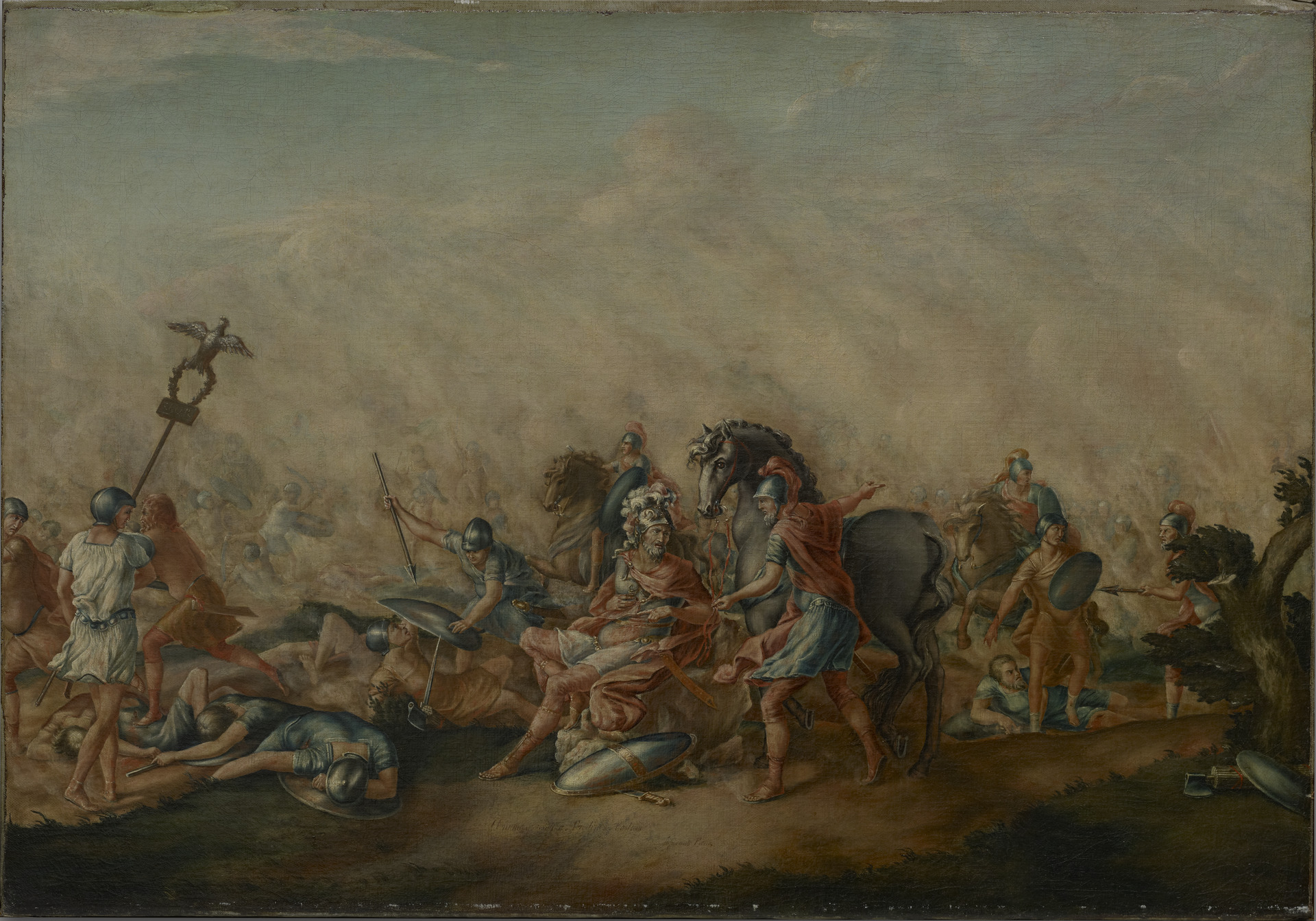
Once those pieces came together, the Romans had no easy exit. Paullus died in the fighting; Varro escaped with a small mounted party. Former consuls and many subordinate officers were lost. Polybius describes the shrinking Roman position as its outer ranks were cut down. His account emphasizes courage on both sides. That is worth remembering. Rome did not lose because its soldiers forgot how to fight. They fought in a situation where courage could no longer solve the geometry, command, and exhaustion of the battle. [1]
A battlefield account cannot recover the experience of each man in the mass. Dust and bodies blocked vision. Orders may have arrived late, if at all. Some fought enemies in front; others were struck from the side or rear; others never reached an enemy before becoming trapped among their own ranks. Modern studies of ancient combat rightly challenge any picture of perfectly synchronized blocks of soldiers moving like one mechanism. The large-scale maneuver is intelligible. Its execution was messy, violent, and uncertain. [6, 7]
Losses and the limits of arithmetic
Polybius reports about 70,000 Roman infantry dead, some 10,000 prisoners associated with the camps, and perhaps 3,000 infantry who escaped the fighting to nearby towns; he gives Carthaginian losses at about 5,700, most of them Celts. Livy gives 45,500 Roman infantry and 2,700 cavalry killed in his principal tally, with other prisoners and survivors dispersed among camps and towns. The categories and totals do not line up cleanly. We should not split the difference and announce a mathematically precise modern answer. Both accounts portray a catastrophic Roman defeat. The scale is secure; the exact ledger is not. [1, 2]
The dead included Paullus and a remarkable share of Rome's political and military leadership. The effect reached beyond combat strength. Households lost sons, clients lost patrons, magistracies needed filling, and allied towns had to decide whether Rome remained a safe bet. Hannibal's army had also taken real losses, especially in the center, and its survivors were exhausted. Tactical victory was overwhelming, but an army after such a battle did not instantly become a fresh siege force. [1, 2]
Roman survivors gathered at Canusium and Venusia and in the camps. Livy preserves competing stories about the prisoners and the Senate's refusal to ransom them. He describes fear in Rome, emergency levies, religious measures, and a determination to continue. The moral speeches in his account should not be repeated as verbatim Senate minutes. Yet the broader sequence is not in doubt: the Roman state did not sue for peace, and it organized new forces after a defeat that could plausibly have ended another state's war. [1, 2, 3]
The decision after the decision
Livy tells the famous story of Maharbal urging Hannibal to march directly on Rome and promising that he could dine on the Capitol within five days. Hannibal asks for time to consider it; Maharbal reproaches him for knowing how to win but not how to use victory. It is a superb line. It is not proof that Rome could have been taken. The exchange appears in a later Roman narrative, and historians debate its authenticity, the identity and presence of the speaker, and what a rapid march might have achieved. A memorable quotation can make a strategic question look settled when it is barely opened. [2, 5]
What would marching on Rome mean? Cavalry could threaten roads and alarm citizens, but cavalry alone could not occupy a fortified city. Hannibal's infantry would have to move after a punishing battle, provision itself, approach defensive works, and either storm, besiege, or negotiate. Rome still possessed walls, people, magistrates, and forces elsewhere. A demonstration might panic the Senate or accelerate defections; it might also fail and advertise that Hannibal could win in the field yet not enter the capital. We cannot rule out a different outcome, but neither can we award him Rome as an automatic post-battle objective. [2, 3, 4, 5]
Hannibal instead pursued the political result for which his invasion had been designed. Capua and other communities in southern Italy moved toward him. Philip V of Macedon entered an alliance with Carthage; events in Sicily also complicated Rome's war. Yet Rome retained crucial allies and continued to recruit. The Italian alliance system bent, but did not break in the way Hannibal needed. His victory could win a day's battle and prompt local decisions. It could not compel every city, colony, and Latin ally to make the same decision. [1, 3, 4]
Why Rome survived
Rome's resilience was not a magical national virtue. It had institutions that could replace magistrates, mobilize citizens and allies, raise money, and send armies to several theaters at once. It also had political relationships that survived panic. Those relationships were unequal and sometimes coercive, but they gave Rome a depth of manpower and obligation that Hannibal could not destroy in one battle. The Republic chose to keep fighting. The distinction is essential: resources make endurance possible; political decisions determine whether those resources are used. [1, 3, 4]
The Romans also changed the kind of war they offered Hannibal. Avoiding another Cannae did not mean hiding behind walls for fifteen years. Roman commanders contested towns, guarded allies, recovered positions, and exploited the fact that Hannibal's army could not be in every theater at once. Rome retained activity in Iberia, Sicily, and at sea. The Carthaginian commander had to protect defectors and seek supplies while Roman forces could threaten the networks on which his campaign depended. Victory at Cannae enlarged his political opportunity; it also gave him new commitments to defend. [3, 4]
In the longer war, Rome recaptured Capua in 211 and Tarentum in 209. Roman successes in Iberia weakened Carthage's position there. Publius Cornelius Scipio later carried the war to Africa, forcing Hannibal's recall; he defeated him at Zama in 202. None of that was written into the dust at Cannae. It took years of hard choices and fresh losses. But it shows why the sentence 'Hannibal won Cannae' cannot be made to mean 'Carthage almost certainly won the war.' The first is a battlefield fact. The second requires an argument about alliances, logistics, sea power, and the political will of two states. [3, 4]
What the victory actually demonstrates
Cannae is frequently reduced to a recipe: weaken the center, strengthen the wings, let the enemy advance, and close the bag. Recipes are tempting because they promise repeatability. Hannibal's achievement was more demanding. He induced the Romans to attack where his cavalry advantage mattered; he accepted pressure and casualties in his center; he preserved the African infantry for decisive flank work; and his cavalry won, redirected, and arrived in time. The plan combined troop qualities with an opponent's likely response. It was not a magic formation laid on the ground before the Romans appeared. [1, 6, 7]
Polybius draws an explicit lesson about cavalry superiority. We should take him seriously without turning his remark into a universal law that cavalry always decides battles. Here cavalry first removed Roman horse, then prevented relief to the infantry, then struck a trapped formation from the rear. Its effects were sequential and mutually reinforcing. If the Roman horse had held longer, or if Hannibal's center had broken before Hasdrubal returned, superiority on a roster would have meant little. A useful history of Cannae asks when each advantage became usable. [1]
The other lesson is political. Hannibal achieved the battlefield result he sought and gained significant defections, yet he did not break the central structure of Roman power. Rome suffered an appalling defeat and adapted. A good operational study must therefore let both things be true: Hannibal's plan was extraordinarily successful, and his strategic problem remained unsolved. That is not a criticism of his skill. It is a recognition that armies fight inside societies, not in a sealed tournament bracket. [1, 3, 4]
What if Rome had won?
The plausible alternative is not that Roman infantry suddenly became immune to cavalry. It is that one of Hannibal's necessary conditions failed. Paullus and Varro might have declined battle on the open plain and maneuvered toward ground less favorable to horsemen. If they still fought, a wider deployment and a protected reserve could have limited the inward rush and guarded a flank. Roman cavalry might have delayed Hasdrubal long enough for the infantry fight to be decided. Or Hannibal's Iberian and Celtic center, which took heavy losses in the historical battle, might have broken too early for the African flanks to act. Each change has a different price and a different chance of success. [1, 2]
Branch one: no decisive battle at Cannae
Rome keeps its huge army and its alliance credibility. Hannibal still occupies a supply point and remains dangerous; Rome still must feed its men and protect towns. A refusal to fight buys options, not victory. If Roman commanders can force a battlefield with restricted cavalry room or strain Hannibal's supply, the balance changes. If they simply watch him raid, allied confidence may suffer anyway.
Branch two: a costly Roman battlefield victory
Suppose the Roman infantry contains the Carthaginian center while a reserve checks the Africans and the cavalry prevents a rear attack. Hannibal's coalition army could suffer losses it cannot readily replace in Italy. Towns considering defection may stay with Rome. Carthage might continue the war through Iberia and at sea, but its best opportunity to dismantle Rome's Italian alliances would narrow sharply. This is a plausible strategic advantage, not a guarantee of an immediate Carthaginian surrender.
Branch three: Hannibal wins, then threatens Rome
A rapid march could magnify Roman panic and perhaps provoke negotiations or more defections. It could also expose an exhausted army to the demands of a siege it could not sustain. The claim that a march would have won the war needs a further claim: how Rome's defenses, remaining armies, and allied system would fail. Livy's anecdote supplies drama, not that missing mechanism. [2, 5]
Of these, the strongest counterfactual is the least theatrical: no Roman attack on that particular ground. The Republic could have remained under intense political pressure, but it would have retained the army and the option to seek a better contest. The most famous alternative—Hannibal at Rome—is interesting precisely because it is uncertain. The right question is not whether he could reach the walls. It is what he could do when he arrived. [1, 4, 5]
Putting Cannae on the table
A straight replay that gives Hannibal the historical formation, gives Rome the historical deep center, and then rewards the Carthaginian player for repeating the textbook envelopment is a demonstration, not much of a game. Players know the result. Give them choices that historical commanders actually faced and make those choices costly. The Roman player needs incentives to fight—supply, water, allied confidence, and political pressure—without a rule that forces a suicidal charge. The Carthaginian player needs to create and exploit an opening without receiving an automatic flank attack simply for placing Africans on the wings. [1, 6]
Begin one or two operational turns before the battle. Place Cannae's stores, the river crossings, both Roman camps, watering places, and roads to Canusium and Venusia on a small campaign map. Each turn Rome can guard supply, contest water, shift camps, refuse battle, or deploy; Hannibal can raid, offer battle, protect his own supplies, or attempt a maneuver. Assign an allied-confidence track that falls if Roman territory is abandoned and rises with successful protection. The track should influence reinforcements or political endurance over several turns, not instantly declare a winner after one raid.
On the tactical table, set an open central plain with the river as a meaningful constraint rather than a decorative blue strip. Represent Roman and allied contingents separately enough that losses and command friction matter. Let the Roman commander choose infantry depth and where to hold a reserve. Deeper formations increase forward pressure but reduce lateral response and the number of troops that can fight effectively at once. If he chooses a historical dense center, it should be because the breakthrough is attractive and time matters, not because the scenario orders it. [1]
Give Hannibal's center a controlled-retirement option that requires cohesion checks and accepts casualties. It must not be a guaranteed backward move through friendly troops. If it retreats too quickly, Romans may break through before the Africans engage; if it holds too long, the wings may lose their chance to strike exposed flanks. Allow African infantry to turn inward only when space and timing permit. The cavalry fights need independent results. The Iberian and Celtic horse may win near the river, but should still have to regroup and cross to the other wing; Numidians may pin, evade, and pursue, but they should not behave like heavy shock cavalry. [1, 6, 7]
Set victory conditions on two levels. A tactical Carthaginian victory requires breaking or trapping a substantial part of the Roman field army. A strategic Carthaginian victory requires enough survivors, supplies, and political leverage to make allied defections stick. Rome may lose the table and still preserve a viable campaign if it extracts a reserve and keeps key allies. Conversely, a Roman player who wins the immediate fight by exhausting every unit might find himself unable to chase Hannibal or secure the district. This prevents the final casualty total from doing all the historical thinking.
For a playable alternate setup, conceal Hannibal's center-retirement plan and let the Roman player choose whether to close up the maniples before deployment. Give Paullus and Varro distinct command priorities without reducing either to a fool: Paullus gains a bonus when changing ground or protecting a reserve; Varro gains one when rapidly assembling the army for battle. They share an army and alternate initiative, but either can argue for a course. The tension lies in command continuity and the cost of delay. If one player already knows every hidden order and the other has no meaningful decisions, Cannae will remain a beautiful diagram and a poor game.
Conclusion
Hannibal won one of history's most decisive battles because he understood both his army and the decision he expected Rome to make. His troops did not execute a geometric trick in isolation. They fought a connected series of contests in which the center yielded, the flanks held, and cavalry returned at the moment Roman depth had become confinement. Rome's men fought hard and lost anyway. [1]
Yet the Republic that lost the army survived. Its institutions, remaining allies, and willingness to fight a different kind of war denied Hannibal the political collapse he needed. That is the conclusion worth carrying beyond antiquity. A perfect tactical victory can create a strategic opportunity; it cannot guarantee that an enemy society will accept defeat. On the game table, as in history, the best Cannae begins before the first sword is drawn and does not end when the last unit routs. [1, 3, 4]
Sources and method
Bracketed numbers in the article refer to the works below. Polybius and Livy provide the ancient narratives. Modern scholarship is used to test their assumptions and the mechanics of battle. Strengths, losses, speeches, and the prospect of taking Rome are disputed; numerical claims are attributed rather than presented as certain counts. The tabletop rules and counterfactual branches are Battleward's analytical proposals, not claims found in an ancient source.
- [1] Polybius, Histories 3.107–118, translated in the Internet Ancient History Sourcebook ↗
- [2] Livy, History of Rome 22.34–61, English translation hosted by York University ↗
- [3] Cornelius Nepos, Hannibal: Dickinson College Commentaries, chapter on Cannae ↗
- [4] Dexter Hoyos, Hannibal: Rome's Greatest Enemy, chapter on 216–209 BCE ↗
- [5] Dexter Hoyos, 'Maharbal's bon mot: authenticity and survival,' Classical Quarterly 50 (2000) ↗
- [6] Philip Sabin, 'The Mechanics of Battle in the Second Punic War,' BICS Supplement 67 (1996) ↗
- [7] Martin Samuels, 'The Reality of Cannae,' Militärgeschichtliche Mitteilungen 47 (1990) ↗
Conversation
Reader comments
Discuss the article and keep the conversation civil.
Loading comments…